For IT professionals managing small business networks, the limitations of traditional MPLS circuits are becoming increasingly apparent. High operational costs, rigid architecture, and suboptimal latency for cloud-based applications are common pain points. Migrating to SD-WAN isn’t merely an incremental upgrade; it’s a fundamental architectural shift in network operations, engineered for performance, cost-efficiency, and the demands of modern distributed workloads.
Why Your Business Network Architecture Demands SD-WAN
Managing a small business network has evolved into a complex exercise in resource allocation. You’re contending with an expanding portfolio of SaaS applications, a proliferation of diverse endpoint devices, and a distributed workforce. This is often layered on top of a legacy network infrastructure ill-equipped for these modern traffic patterns.
Traditional Wide Area Networks, particularly those reliant on expensive and inflexible MPLS circuits, were architected for a different era. They typically backhaul all traffic, including cloud-destined data, through a centralized data center. This “tromboning” effect introduces significant latency and performance bottlenecks for real-time applications.
This is where Software-Defined Wide Area Networking (SD-WAN) provides a superior architectural solution. To draw an analogy: your legacy MPLS network is a freight train, restricted to a single, predetermined track. SD-WAN, in contrast, functions as a dynamic, policy-based routing engine for your data packets.
Instead of being locked into a single, high-cost path, SD-WAN intelligently routes application traffic across multiple transport links—such as broadband, fiber, and 5G/LTE—based on real-time path performance metrics and pre-defined business policies.
This dynamic, software-defined approach directly addresses the most pressing networking challenges faced by IT managers today.
Overcoming Legacy Network Constraints
The transition to an SD-WAN overlay delivers immediate and measurable technical benefits. A primary advantage is significant cost optimization. By aggregating multiple, low-cost commodity internet connections, businesses can achieve enterprise-grade reliability and throughput without the high recurring costs of MPLS circuits.
For any small business, high availability is non-negotiable. SD-WAN can substantially improve business continuity by creating a highly resilient network fabric. If a primary circuit experiences an outage or performance degradation (e.g., increased jitter or packet loss), SD-WAN automatically and seamlessly fails over traffic to a healthier link. This ensures the uninterrupted operation of critical services like VoIP, video conferencing, and PoS systems.
To understand the fundamental architectural differences, a direct comparison is necessary. The following table delineates how SD-WAN modernizes the traditional WAN paradigm.
Traditional WAN vs. SD-WAN Technical Comparison
| Feature | Traditional WAN (e.g., MPLS) | SD-WAN |
|---|---|---|
| Traffic Routing | Follows a fixed, pre-configured path based on Layer 3 headers. | Dynamic, real-time path selection based on application policies and link quality metrics. |
| Management | Complex, requires per-device command-line interface (CLI) configuration. | Centralized, orchestrated from a single graphical user interface (GUI). |
| Link Usage | Typically active/passive; backup links are idle until failover. | Actively utilizes multiple links (broadband, 5G/LTE, fiber) in an active/active configuration. |
| Cloud Access | Inefficient; backhauls SaaS/IaaS traffic through a central data center. | Provides direct, secure, and optimized cloud on-ramps. |
| Cost | High Total Cost of Ownership (TCO) due to expensive private circuits. | Lower TCO by leveraging commodity internet connections. |
| Agility | Slow to provision new sites and implement policy changes. | Rapid provisioning (Zero-Touch Provisioning) and policy changes in minutes. |
As illustrated, the paradigm shifts from a rigid, hardware-centric model to a flexible, software-driven architecture that aligns network behavior with business and application requirements.
Meeting Modern Application Demands
The exponential growth of the SD-WAN market underscores its efficacy. The global market is projected to expand from $7.56 billion in 2024 to $10.25 billion by 2025, driven by the demand for simplified network management and lower operational expenditures. You can review detailed market analysis from The Business Research Company. This growth is a direct response to the operational realities of modern distributed enterprises.
With SD-WAN, IT teams gain:
- Centralized Control: Manage the entire WAN fabric from a single orchestrator. Pushing new policies or security rules to all branch locations is executed in a few clicks.
- Application-Aware Routing: The SD-WAN overlay can identify application traffic (e.g., Salesforce vs. YouTube) using Deep Packet Inspection (DPI) and enforce granular path selection policies.
- Enhanced Security: Modern SD-WAN solutions integrate foundational security capabilities, creating a more robust and manageable security posture.
Understanding The SD-WAN Architecture
To fully appreciate SD-WAN’s value proposition for a small business, it’s essential to understand its underlying architecture. The core innovation of SD-WAN lies in the disaggregation of the network control plane from the data plane. This separation creates three distinct planes of operation that work in concert to deliver a more intelligent, agile, and manageable network.
This architecture can be compared to a modern air traffic control system. A central control tower (the control plane) makes high-level routing decisions, which are then executed by the individual aircraft (the data plane). This is a significant evolution from traditional networking, where each router makes independent forwarding decisions based on its local routing table.
The image below provides a visual representation of how these architectural components interoperate to drive benefits like OPEX reduction for small business offices.
This abstracted structure is precisely how SD-WAN enables businesses to reduce operational expenditures while simultaneously enhancing inter-office collaboration and application performance.
The Three Planes Of Operation
At its core, SD-WAN architecture is composed of three logical components, each with a specific function:
-
The Data Plane: This is the forwarding plane of the network. It resides at the network edge—typically as a physical or virtual appliance in an office or remote user’s location—and executes the packet forwarding decisions dictated by the control plane.
-
The Control Plane: This is the centralized intelligence of the architecture. It maintains a holistic view of the network topology, monitors the real-time health of all transport paths (measuring latency, jitter, packet loss), and makes dynamic routing decisions for application traffic. It then propagates these forwarding instructions to the data plane.
-
The Management Plane: This is the single-pane-of-glass administrative interface. It provides the GUI for network administrators to configure the system, define policies, monitor performance, and run analytics. This is where an administrator defines the business intent that the control plane will enforce.
This clear separation of functions provides the flexibility and granular control that make SD-WAN an ideal solution for a small business network.
Key Hardware And Software Components
These three planes are instantiated by specific hardware and software components. The system’s core is the SD-WAN orchestrator, a centralized software platform that embodies both the management and control planes, often hosted in the cloud for high availability and accessibility.
The orchestrator communicates with the edge devices, also known as Customer Premises Equipment (CPE), which are the physical appliances deployed at each business location. These devices constitute the data plane, executing the forwarding commands received from the orchestrator. To facilitate optimized cloud connectivity, SD-WAN gateways are often deployed as virtual instances within major IaaS provider Points of Presence (PoPs). For a deeper dive, review our guide covering the technical details of SD-WAN and cloud integration.
By abstracting network control from the underlying physical hardware, SD-WAN allows IT teams to manage a geographically dispersed network as a single, unified system, rather than a collection of individually configured devices.
This architectural approach is gaining rapid adoption. Projections indicate that by 2025, over two-thirds of enterprise sites will utilize SD-WAN. Small businesses are adopting the technology for the same reasons: to achieve high uptime, enhanced application performance, and secure, simplified network management.
Core Technical Benefits For IT Teams
Moving beyond high-level concepts, let’s examine the specific operational benefits SD-WAN delivers to an IT team. This is where the technology’s value for a small business becomes tangible, addressing persistent network issues that consume significant administrative overhead. These are not merely marketing features; they are functional capabilities that provide granular control and simplify complex network operations.
The tangible outcome is a shift in IT resources from reactive troubleshooting of connectivity issues to proactive initiatives that drive business value. For any IT manager, this represents a significant operational improvement, transforming the network from a source of friction into a strategic business asset.
Dynamic Path Selection and Application-Aware Routing
A primary technical benefit is Dynamic Path Selection. Consider a scenario where an office relies on VoIP for all voice communications. On a traditional network, if the primary WAN link experiences packet loss or high jitter, call quality degrades severely. An SD-WAN solution continuously monitors the performance metrics of all available paths. It can detect a latency spike on the primary link and instantaneously reroute VoIP traffic over a healthier secondary link—often before users perceive any degradation in quality.
This capability is tightly integrated with Application-Aware Routing. An IT administrator can configure a policy stating that traffic identified as Salesforce (via Layer 7 inspection) must be prioritized and routed over the path with the lowest latency. Meanwhile, non-critical traffic like bulk data transfers can be directed over higher-latency, lower-cost links. This provides direct, policy-based control over application Quality of Experience (QoE).
Centralized Management and Simplified Provisioning
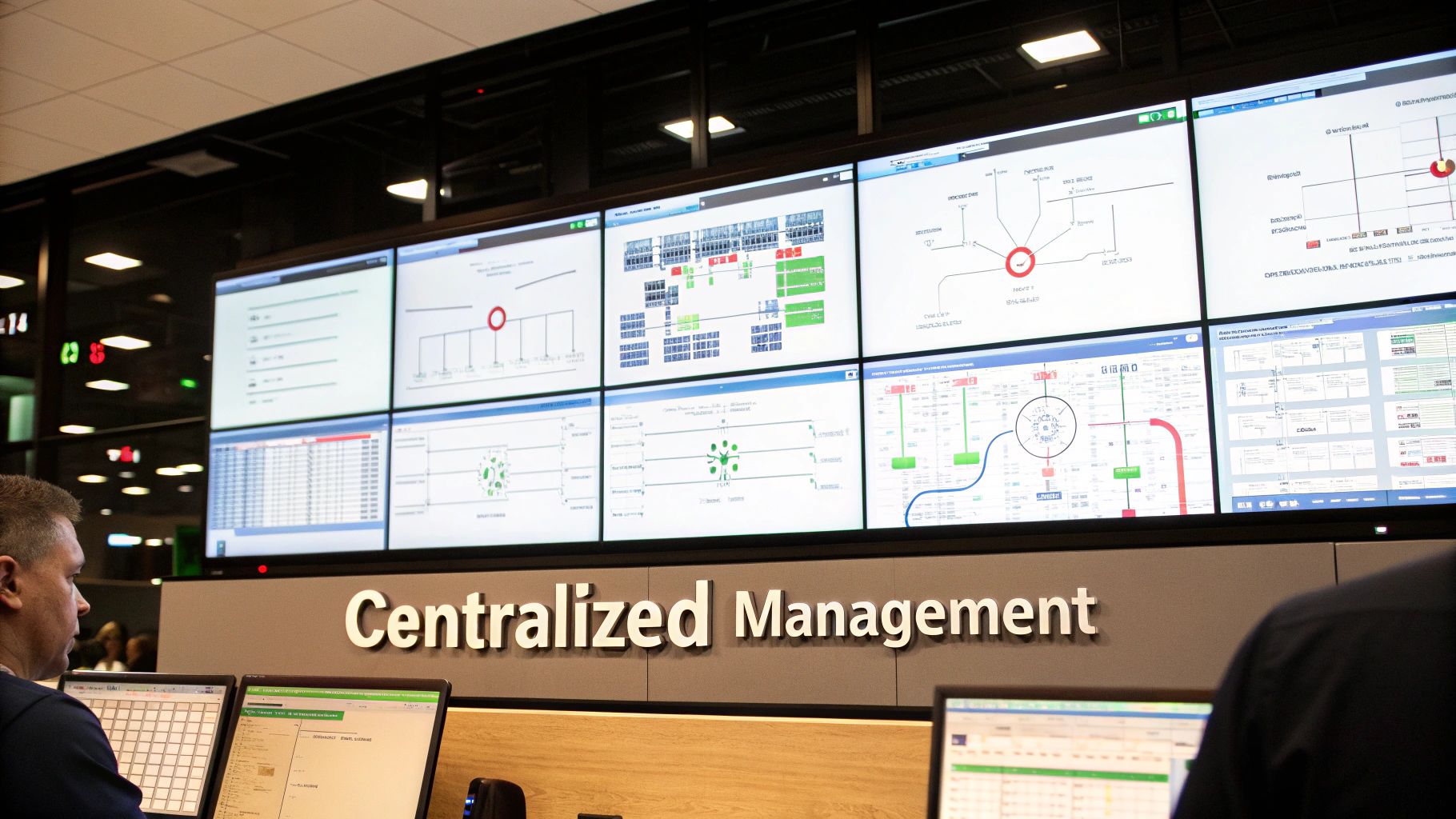
The era of CLI-based, device-by-device configuration is over. SD-WAN provides a single-pane-of-glass dashboard—a centralized orchestrator for complete network visibility and control.
This centralized management paradigm means an administrator can deploy a new security policy or QoS configuration to all sites simultaneously. The reduction in manual effort and potential for human error is substantial.
This simplicity is particularly evident during new site rollout, thanks to a feature called Zero-Touch Provisioning (ZTP). To bring a new branch office online, a pre-configured appliance is shipped to the site. On-site personnel—with no technical expertise required—simply connect the device to power and an internet circuit. The appliance automatically contacts the central orchestrator, downloads its configuration, and securely establishes tunnels to join the WAN fabric. For a growing business, ZTP dramatically reduces deployment costs and time-to-service for new locations.
Integrating Security with SASE Architecture
For any IT team, network performance and security are not disparate functions; they are intrinsically linked. An SD-WAN for small business provides a foundational security uplift out of the box with features like stateful firewalls, standards-based IPsec encryption for site-to-site traffic, and micro-segmentation capabilities to contain lateral threat movement. These are significant improvements over a traditional WAN topology.
However, the concept of a secure “network perimeter” has dissolved. Users, devices, and applications are now highly distributed, necessitating a more sophisticated security architecture. This is where the industry conversation evolves from SD-WAN to a model known as Secure Access Service Edge (SASE).
SASE should not be viewed as a replacement for SD-WAN, but rather as its architectural evolution. It converges the intelligent networking capabilities of SD-WAN with a comprehensive suite of cloud-native security services. For small businesses seeking enterprise-grade security without the associated complexity, SASE is a transformative model.
The Convergence of Networking and Security
So, what is SASE, technically? It involves integrating SD-WAN’s intelligent path selection with a robust set of security functions delivered from a cloud-based Point of Presence (PoP). Instead of deploying and managing a stack of physical security appliances, SASE delivers Security as a Service.
This cloud-native security stack typically includes several key components:
- Secure Web Gateway (SWG): Provides URL filtering, malware detection, and policy enforcement for all web traffic, regardless of user location.
- Cloud Access Security Broker (CASB): Offers visibility and control over SaaS application usage, enforcing data loss prevention (DLP) policies and preventing unauthorized access.
- Zero Trust Network Access (ZTNA): Operates on the principle of “never trust, always verify,” providing identity-aware access to specific applications rather than broad network access.
- Firewall as a Service (FWaaS): Delivers next-generation firewall (NGFW) capabilities from the cloud, ensuring consistent policy enforcement across the entire organization.
Why SASE Is a Breakthrough for SMBs
This converged, cloud-delivered model is highly advantageous for small businesses. It eliminates the inefficient practice of “traffic hairpinning,” where remote and cloud-bound traffic must be backhauled to a central data center for security inspection—a process that introduces significant latency.
With a SASE architecture, a remote user’s traffic is directed to the nearest SASE PoP, where the full security stack is applied before the traffic is forwarded to its destination.
The practical result? Every user, whether in the office, at home, or mobile, receives a consistent security posture and a high-performance, direct-to-app connection. This strengthens security defenses while simultaneously simplifying network architecture.
Businesses are increasingly recognizing these benefits. Current data shows that SD-WAN adoption driven primarily by security requirements is at 7%, with another 14% of companies actively conducting pilot programs. These statistics reflect a growing confidence in converged platforms. For more detailed data, you can review industry SD-WAN trends at TWC IT Solutions.
For any small business, these trends highlight the strategic value of selecting a platform where networking and security are cohesively integrated from the ground up. To explore this topic in greater detail, see our guide on SD-WAN and cybersecurity.
How To Select The Right SD-WAN Solution
Selecting the optimal SD-WAN solution for your small business requires a structured evaluation process. It’s not merely a comparison of features and pricing, but a strategic assessment to identify a system that aligns with current operational requirements and future growth trajectories. The objective is to select a solution that demonstrably improves network performance, security posture, and manageability.
The process should begin with a thorough audit of your current network environment. This involves documenting all physical locations, quantifying remote users, and inventorying business-critical applications and their performance requirements. Analyze current bandwidth utilization and forecast future needs, particularly concerning the migration of additional workloads to the cloud.
This initial due diligence forms the foundation of the decision-making process, ensuring you avoid over-provisioning or selecting a solution that cannot scale with business growth.
Evaluating Deployment Models
Next, determine the operational model for managing the SD-WAN solution. There are three primary models, and the optimal choice depends on the size and technical expertise of your IT team.
- Do-It-Yourself (DIY): In this model, your in-house IT team assumes full responsibility for the entire lifecycle, from procurement and deployment to ongoing management and troubleshooting. This offers maximum control but requires significant in-house networking expertise and resources.
- Co-Managed: A hybrid model that divides responsibilities between your internal team and the SD-WAN vendor or a Managed Service Provider (MSP). For instance, the internal team might manage day-to-day policy changes, while the provider handles platform updates, hardware maintenance, and Tier 2/3 support.
- Fully Managed: In this model, the entire SD-WAN service is outsourced to the vendor or MSP. They handle all aspects of deployment, management, monitoring, and support. This is often the most practical model for small businesses with limited IT staff, freeing them to focus on strategic initiatives rather than network administration.
SD-WAN Deployment Model Comparison For SMBs
To aid in your decision, the following table compares these models. Evaluate them against your team’s current operational capacity and technical skillset.
| Deployment Model | Best For | IT Team Involvement | Cost Structure |
|---|---|---|---|
| Do-It-Yourself (DIY) | Businesses with a dedicated, experienced network engineering team seeking maximum customization and control. | High: The internal team manages all aspects of deployment, configuration, monitoring, and troubleshooting. | Higher upfront capital expense (CapEx) for hardware, but lower recurring operational expenses (OpEx). |
| Co-Managed | Companies with some IT staff who want to offload complex tasks but retain control over daily network policies. | Medium: The internal team and the provider share responsibilities based on a pre-defined agreement. | Balanced mix of CapEx and OpEx. You pay for hardware and a monthly management fee. |
| Fully Managed | Small businesses or those with limited IT resources that need an expert to handle the entire SD-WAN lifecycle. | Low to None: The MSP or vendor handles everything from setup to ongoing maintenance and support. | Primarily an operational expense (OpEx) model with predictable monthly costs, often with little to no upfront cost. |
While the DIY model may appear to have the lowest direct cost, the indirect operational costs in terms of staff time and resource allocation can be substantial. For many small businesses, a managed service provides a more predictable and often lower Total Cost of Ownership (TCO).
Scrutinizing Vendor Support and Security
Once you’ve defined your requirements and preferred management model, conduct a detailed vetting of potential vendors. Pay close attention to their Service Level Agreements (SLAs). What are their guarantees for uptime, mean time to recovery (MTTR), and support response times for critical incidents? A robust, clearly defined SLA is your contractual assurance of service quality.
Security is equally critical. Evaluate the vendor’s native security features, such as integrated next-generation firewalls (NGFW) and intrusion prevention systems (IPS). Beyond these, inquire about their roadmap and strategy for SASE (Secure Access Service Edge).
A vendor without a clear, integrated strategy for delivering cloud-native security services like Zero Trust Network Access (ZTNA) and Secure Web Gateway (SWG) may not be equipped to meet your evolving security requirements.
Finally, verify the solution’s performance with your critical cloud platforms. If your business relies heavily on IaaS/PaaS providers like AWS, Azure, or Google Cloud, request performance benchmarks or case studies. The vendor should be able to provide concrete data demonstrating how their solution optimizes and secures traffic to these specific environments. A thorough vetting process will ensure you select a strategic partner, not just a product vendor. To further inform your evaluation, review these best practices for SD-WAN.
Getting Down to Brass Tacks: Your SD-WAN Implementation Questions Answered

You’ve concluded that deploying an SD-WAN for your small business is the correct strategic decision. Now, the focus shifts to the practicalities of implementation. Migrating to a new WAN architecture is a significant network change, and clarifying the technical details is a critical prerequisite.
This section addresses the most common technical questions from IT professionals evaluating an SD-WAN migration. These are the real-world implementation challenges and opportunities you will encounter. Let’s provide direct, technical answers to facilitate a confident and well-planned deployment.
Can I Really Just Use My Current Internet Connections?
Yes, and this is a fundamental design principle of SD-WAN. The technology is inherently transport-agnostic. This means the SD-WAN overlay is abstracted from the underlying physical transport layer. It can aggregate heterogeneous circuits—including existing business broadband, fiber, and 4G/5G LTE—into a single, unified network fabric.
The SD-WAN appliance functions as a traffic-forwarding engine that sits on top of your bandwidth. It creates a virtual pool of all available transport links and continuously monitors the real-time performance metrics of each path, including latency, jitter, and packet loss.
From there, routing is determined by user-defined policies. For example, you can create a policy to route mission-critical VoIP and video conferencing traffic over the low-latency fiber circuit, while less-sensitive bulk data backups are directed over the higher-capacity broadband connection. This allows you to optimize application performance while controlling circuit costs.
How Does This Actually Secure Our Remote and Hybrid Team?
SD-WAN provides a significant security enhancement for a distributed workforce, particularly when deployed as part of a SASE (Secure Access Service Edge) framework. The architecture begins with a lightweight software client on an end-user’s device or a small hardware appliance in their home office. This client establishes an encrypted tunnel to the nearest SD-WAN gateway, effectively extending the corporate security policy to the remote endpoint.
In a full SASE model, security is further enhanced. A remote user’s traffic is automatically routed to the nearest cloud-based SASE Point of Presence (PoP). At the PoP, a full stack of security services—including Zero Trust Network Access (ZTNA) and a Secure Web Gateway (SWG)—inspects traffic before it is granted access to corporate resources.
The outcome is a consistent and robust security posture for all users, regardless of location, without the performance penalty of backhauling traffic through a centralized data center firewall.
What Does a Typical Rollout Look Like for a Small Business?
The deployment process is engineered for efficiency, typically leveraging a methodology called Zero-Touch Provisioning (ZTP). The primary objective of ZTP is to eliminate the need for on-site IT expertise at each branch location. The process is highly streamlined and generally follows four distinct phases:
- Design and Policy Creation: Working with your provider, you analyze your network traffic profiles and business requirements. This phase involves defining the core SD-WAN policies, such as application prioritization (QoS), security rules, and failover criteria.
- Centralized Pre-configuration: Before any hardware is deployed, the entire network configuration is provisioned within the cloud-based orchestrator. All site-specific information, security policies, and traffic-steering rules are programmed and staged for deployment.
- Zero-Touch Deployment: Appliances are shipped directly to each branch or remote user location. On-site personnel connect the device to power and an internet circuit. The device automatically initiates a secure connection to the orchestrator, downloads its pre-defined configuration, and builds the necessary IPsec tunnels to join the WAN fabric.
- Validation and Optimization: From the centralized dashboard, your IT team verifies that all sites are online and that traffic is being forwarded according to policy. Any subsequent policy adjustments can be made centrally and pushed to all devices instantaneously.
Ready to see how broadband bonding and intelligent SD-WAN can create a faster, more resilient network for your business? Mushroom Networks Inc. provides powerful multi-WAN devices that combine diverse internet links to guarantee uptime and optimize application performance. Our solutions include built-in firewalls and advanced Quality of Service (QoS) to ensure your team stays productive.
Discover our advanced networking solutions at https://www.mushroomnetworks.com.