Enterprise network security is the practice of protecting an organization’s digital infrastructure. This has evolved beyond securing a single perimeter to encompass complex, distributed environments comprising cloud services, a remote workforce, and interconnected branch offices. This new reality demands a far more integrated and technically robust approach than a traditional stateful firewall can provide.
The Imperative for Modern Enterprise Network security
The days of securing a centralized, hub-and-spoke corporate network are over. Today’s enterprise environment is a distributed mesh of remote endpoints, SaaS applications, and IaaS workloads, with data traversing myriad public and private networks.
This architectural shift has rendered the traditional “castle-and-moat” security model obsolete. Instead of a single perimeter to defend, IT professionals are now responsible for securing thousands of individual endpoints and connections. Each remote laptop, cloud service instance, and branch office link represents a potential attack vector, creating a massive and dynamic attack surface.
Consequently, organizations face a constant barrage of sophisticated cyberattacks designed to exploit these distributed vulnerabilities. Mitigating these threats is no longer a routine IT function; it’s a core operational requirement for maintaining business continuity and protecting sensitive data assets.
The Technical Drivers for Advanced Security
Viewing robust security as a mere cost center is an outdated perspective. It is a strategic enabler for modern, distributed operations. The adoption of advanced enterprise network security solutions is driven by several key technical requirements:
- Enabling a Distributed Workforce: Securely connecting a remote workforce requires consistent policy enforcement and threat protection, irrespective of the user’s location or network access method.
- Supporting Cloud Migration: As critical applications and data workloads migrate to the cloud, security controls must follow. This necessitates granular visibility and control over traffic flowing to, from, and between IaaS, PaaS, and SaaS environments.
- Ensuring Business Continuity and Resilience: A security breach can trigger catastrophic downtime, financial loss, and reputational damage. Proactive, automated security measures are the foundation of a resilient and fault-tolerant infrastructure.
The move towards comprehensive security strategies is a market imperative, not just a trend. The U.S. enterprise network security market, valued at USD 5.3 billion today, is projected to more than double, reaching nearly USD 11.6 billion by 2033. This growth underscores the critical need for organizations to invest in modern defensive architectures. You can explore more data on this market growth and its drivers.
A Look Under The Hood: The Secure SD-WAN Architecture

To properly understand modern enterprise network security solutions, it’s essential to analyze the architecture of Secure SD-WAN. This is not just an industry buzzword; it represents a paradigm shift in how wide area networks (WANs) are built, managed, and secured. It signifies a move from rigid, hardware-centric models to an agile, software-defined approach.
A traditional WAN is analogous to a fixed set of physical circuits connecting distributed sites. If a primary circuit—such as an expensive MPLS link—experiences high latency or an outage, traffic routing is manually reconfigured, or it fails over to a passive backup, often resulting in service disruption. This model is slow, costly, and lacks the agility required by modern enterprises.
Secure SD-WAN, in contrast, functions as an intelligent, automated overlay network. It abstracts the underlying transport hardware—broadband, fiber, 4G/5G—into a single, programmable fabric. If one transport path degrades or fails, the SD-WAN controller can intelligently and automatically reroute traffic flows to the next best path based on predefined policies. This ensures high availability and optimal application performance.
How Security Is Natively Integrated Into the Network Fabric
The core value proposition of Secure SD-WAN is its native integration of security functions directly into the network fabric. Instead of deploying security as a bolt-on appliance, which was standard practice with traditional WANs, this architecture builds a cohesive, unified defense from the ground up. This approach simplifies management and significantly strengthens the overall security posture.
This tight integration is fueling its market expansion. The global network security market, already valued at USD 27.11 billion this year, is expected to surge to USD 79.29 billion by 2033. This is not just a forecast; it is being realized in practice. Major players like Fortinet recently reported that 11 new major managed security service providers—from Saudi Telecom Company to KT Corporation in South Korea—have adopted their Secure SD-WAN solution. This global adoption demonstrates how enterprises are leveraging integrated security to enhance network performance without compromising data integrity. You can review the data in the full report from Grand View Research.
At its core, Secure SD-WAN provides centralized command and control over a distributed network. It empowers IT administrators to define, manage, and enforce security policies from a single management console and propagate them to every connection point—from the corporate HQ to a branch office or a remote user’s endpoint.
Key Security Benefits Of An SD-WAN Architecture
Migrating to a Secure SD-WAN architecture delivers numerous security advantages that are difficult to achieve with legacy network models. These benefits directly address the challenges posed by distributed workforces and cloud-centric application delivery.
The security pillars of SD-WAN include:
- Centralized Policy Management: From a single pane of glass, IT administrators can create and deploy consistent security policies across the entire network fabric. This eliminates policy drift between sites and guarantees uniform protection for all users and locations.
- Secure Micro-segmentation: SD-WAN enables the logical partitioning of the network into smaller, isolated segments. This is a critical capability for lateral movement prevention. For instance, an organization can isolate IoT devices or guest Wi-Fi networks from segments containing sensitive corporate data. If one segment is compromised, the breach is contained and cannot easily propagate across the network.
- Automated Threat Intelligence Integration: Modern solutions integrate with real-time threat intelligence feeds. This allows the network to automatically identify and block known malicious IP addresses, domains, and malware signatures at the edge, preventing threats from penetrating the network.
- End-to-End Encryption: All traffic traversing the SD-WAN overlay is automatically encrypted via IPsec tunnels, regardless of the underlying transport medium (MPLS, broadband, or LTE). This secures data in transit against eavesdropping and man-in-the-middle attacks.
By converging networking and security, these solutions provide the deep visibility and granular control required for effective network performance optimization. This unified approach not only improves operational efficiency for IT teams but also closes the security gaps inherent in managing disparate point products.
Integrating Multi-WAN and Next-Generation Firewalls
Utilizing a diverse mix of WAN connections—such as a primary MPLS circuit, a high-speed broadband link, and a 4G/5G LTE backup—is an effective strategy for building a high-performance, resilient network. This approach creates redundancy; if one connection fails, traffic is automatically rerouted to an active link, ensuring service continuity. However, each additional connection expands the organization’s attack surface, introducing new potential ingress points for attackers.
This is precisely why integrating enterprise network security solutions into the network fabric is no longer optional. Operating multiple internet connections without a unified security strategy is analogous to adding multiple entry points to a building without installing locks. It is critical to inspect and secure all traffic traversing every connection with a consistent set of security policies.
The Rise of the Integrated Firewall
To address this elevated risk, modern network architectures integrate security directly into the connectivity layer. The legacy approach—deploying separate, standalone firewalls at each branch office—creates significant management overhead and policy inconsistencies. The superior approach is to integrate a Next-Generation Firewall (NGFW) directly into the SD-WAN appliance or service. This convergence is the essence of Secure SD-WAN.
When security is integrated in this manner, it ceases to be an afterthought or an additional managed device. It becomes an intrinsic component of the network, applying intelligent, context-aware protection to all data flows.
It is no surprise that core security tools like firewalls and VPNs are nearly universally adopted. However, recent industry data reveals key insights into security tool deployment.
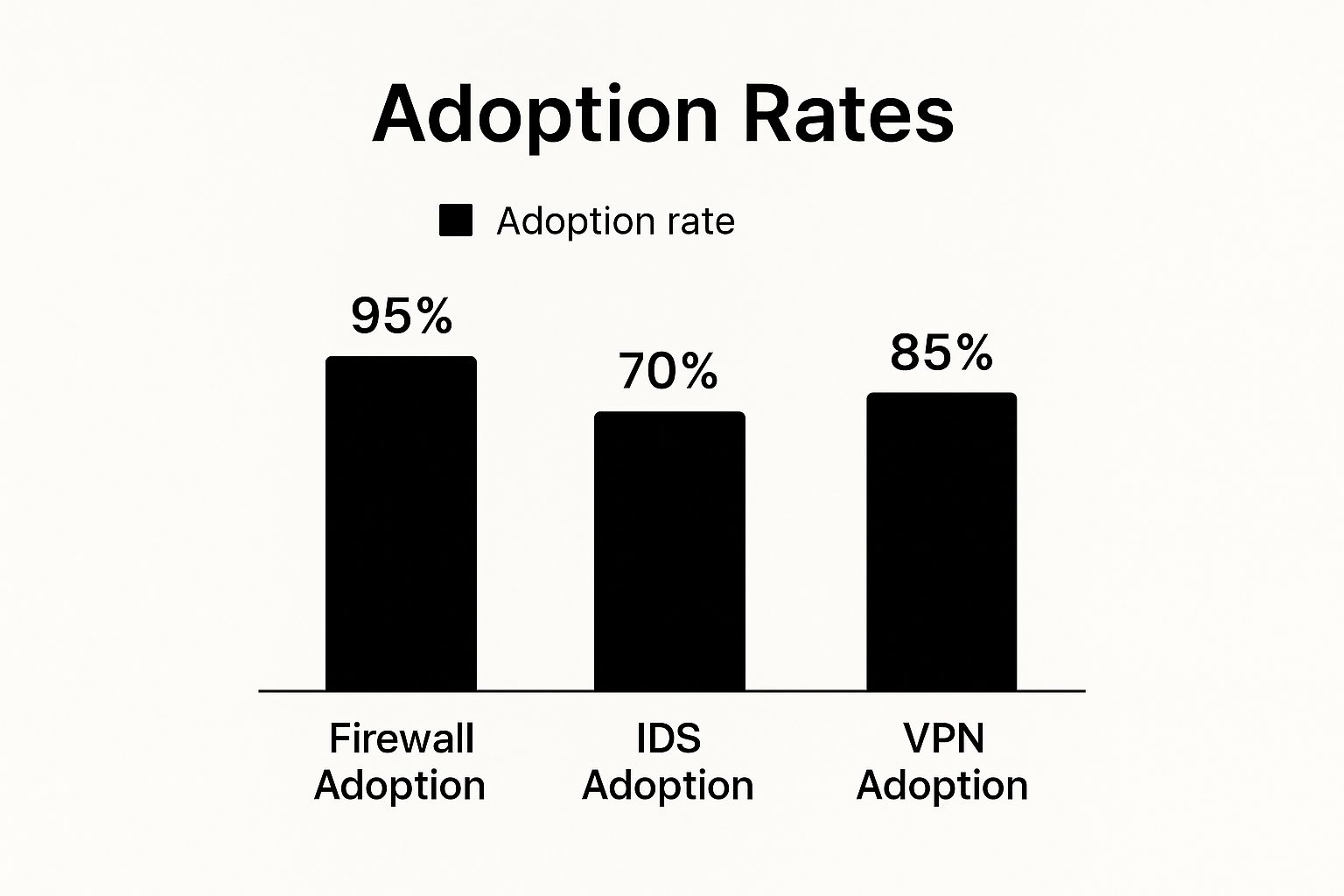
The data indicates that while 95% of businesses have deployed firewalls, the adoption of more advanced capabilities like Intrusion Detection Systems (IDS) is at 70%. This gap highlights the value of integrated NGFWs, which provide a more comprehensive, all-in-one security stack.
To understand the architectural shift, it is useful to compare the traditional versus the integrated approach to firewall deployment. The traditional method is cumbersome and creates security silos, whereas the integrated SD-WAN model provides centralized control and consistent protection across the entire enterprise.
Comparing Traditional vs SD-WAN Integrated Firewall Approaches
| Feature | Traditional Firewall Architecture | Integrated Secure SD-WAN Architecture |
|---|---|---|
| Management | Decentralized management for each firewall at every location | Centralized, single-pane-of-glass management for the entire network |
| Policy Consistency | Prone to inconsistencies and configuration drift between sites | Unified security policy applied consistently across all branches and WAN links |
| Visibility | Siloed visibility; difficult to get a holistic view of network traffic | Complete, end-to-end visibility across the entire WAN from one dashboard |
| Deployment | Requires on-site configuration and management for each device | Zero-touch provisioning; policies pushed from the central controller |
| Scalability | Complex and costly to scale; requires provisioning new hardware | Highly scalable; new sites inherit security policies automatically |
This comparison clarifies why IT leaders are migrating away from managing fleets of disparate firewalls. The integrated model is not merely simpler; it is fundamentally more secure and agile.
Essential NGFW Capabilities for a Distributed Network
A true NGFW offers capabilities far beyond the basic port and protocol filtering of a traditional stateful firewall. For a distributed enterprise, several NGFW features are non-negotiable for achieving effective security.
These capabilities provide the deep packet inspection and granular control needed to defend a modern, multi-WAN environment against sophisticated threats.
Key NGFW functions include:
- Application-Aware Filtering (Layer 7 Visibility): This is a critical feature. It allows the firewall to identify and control traffic based on the application generating it, not just its port and protocol. For example, an administrator can create a policy that permits access to Microsoft 365 while blocking a non-sanctioned file-sharing application, even if both use the same protocol (HTTPS on port 443).
- Intrusion Prevention Systems (IPS): An integrated IPS functions as an inline security service that actively scans network traffic for known attack signatures and anomalous behavior patterns. Upon detecting a potential exploit, it can immediately block the malicious traffic before it reaches its target server or endpoint.
- Unified Threat Management (UTM): UTM consolidates multiple security functions onto a single platform. A UTM-enabled NGFW typically includes antivirus, anti-spam, web content filtering, and malware detection, providing layered security without the complexity of managing multiple point products.
By converging these powerful features, a Secure SD-WAN solution can enforce a single, unified security policy across every WAN connection at every location. This consistency is what closes security gaps and improves operational manageability for IT teams.
How It Works in a Secure SD-WAN Context
Consider a retail enterprise with hundreds of stores. Each store utilizes a primary broadband connection and a 4G LTE link for failover.
With an integrated NGFW in their SD-WAN, the central IT team can author a single master security policy and deploy it to every store via the central controller. This policy could, for example, block all traffic from geolocations associated with malicious activity, restrict point-of-sale terminals to communicate only with the payment processor’s server, and perform malware scanning on all inbound file transfers. Critically, this exact same policy is enforced automatically on both the primary broadband and the 4G backup link at every store.
If a new ransomware threat emerges, the IT team can update the security policy once from the central controller and instantly deploy it to all 2,000+ endpoints across the company. This centralized command and control delivers uniform, responsive, and scalable security—an outcome that is nearly impossible to achieve when manually managing hundreds of disparate firewalls.
Using QoS for Security and Performance

When most IT professionals hear “Quality of Service” (QoS), they typically think of performance optimization—ensuring low latency for VoIP calls or jitter-free video conferences. While this is a primary use case, it represents only half of its capability. In a modern network, QoS is also a powerful and often underutilized security mechanism.
By providing granular control over bandwidth allocation, QoS can be used to actively defend the network. It functions as a traffic management system for data flows. While its primary role is to direct legitimate traffic to optimize performance, this position gives it a unique capability to identify and deprioritize suspicious activity before it can cause a service-impacting event.
This dual function is a fundamental component of advanced enterprise network security solutions. Instead of operating in a purely reactive defense posture, administrators can use QoS to proactively shape traffic flows. This creates a network that is not only high-performing but also inherently more resilient against certain classes of attacks.
Prioritizing Traffic as a Defensive Strategy
At its core, QoS is about traffic prioritization. The administrator defines policies that dictate the forwarding priority of different data packets. Traditionally, this meant assigning high priority to real-time applications like voice and video.
A security-centric approach extends this same logic. QoS policies can be configured to give the highest priority to critical security and operational traffic. This guarantees that even when the network is under duress—for example, during a Distributed Denial-of-Service (DDoS) attack—the most important management and security systems remain accessible.
Consider these practical examples:
- Security Information and Event Management (SIEM) Logs: By assigning a high-priority class to log traffic, you ensure that critical security alerts from firewalls, servers, and endpoints are delivered to the SIEM platform without delay. During an active attack, this speed is crucial for timely detection and response.
- Administrator Access: A dedicated, high-priority queue can be reserved for SSH or RDP traffic originating from specific IT admin subnets. This ensures that even if the network is saturated, the response team can still access infrastructure to manage and mitigate the threat.
- Authentication Services: Traffic to and from critical services like Active Directory or other identity providers can be prioritized. This prevents a flood of malicious traffic from causing a denial of service for legitimate users attempting to authenticate to applications.
By creating protected bandwidth channels for these essential communications, you ensure visibility and control are maintained precisely when they are needed most.
Using QoS to Mitigate Attacks and Protect Applications
Beyond prioritizing legitimate traffic, QoS can be used to actively sideline or rate-limit traffic that exhibits suspicious characteristics. This is where it becomes a direct security instrument. Modern, application-aware QoS systems can identify traffic not just by its port and protocol, but by the application generating it, providing a high degree of control.
A key advantage of modern QoS is its ability to adapt in real-time. Instead of static, rigid rules, dynamic QoS can adjust policies based on changing network conditions and threat levels, providing a more intelligent and responsive defense.
Imagine the network is targeted by a high-volume flood of unclassified traffic from a limited set of source IPs—a classic volumetric DDoS attack. An intelligent QoS system can detect this anomaly, classify the traffic as low-priority or “scavenger” class, and assign it to a queue with minimal bandwidth allocation.
This single action accomplishes two critical objectives:
- It Shields Critical Applications: Business-critical platforms—the CRM, ERP, and VoIP systems assigned to high-priority queues—continue to function without performance degradation. The attack fails to achieve a “denial of service” for mission-critical applications.
- It Contains the Threat: By throttling the suspicious traffic, you prevent it from consuming all available bandwidth and overwhelming state tables on the firewall. This provides the security team with the time necessary to investigate the source and implement a permanent block.
For administrators looking to implement these policies, a solid understanding of the fundamentals is essential. A detailed guide on configuring these traffic-shaping tools can be found in our article on Quality of Service setup. When configured correctly, these policies elevate QoS from a simple performance-tuning tool to a dynamic and vital layer in your security architecture.
A Framework for Deploying Network Security Solutions

Deploying new enterprise network security solutions is a complex undertaking, requiring more than just a hardware refresh or software installation. A successful deployment necessitates a methodical, phased approach that minimizes business disruption while systematically improving the organization’s security posture.
Without a structured plan, even the most advanced technology can fail to deliver its intended value, resulting in configuration gaps, operational friction, and, in the worst-case scenario, new vulnerabilities. This framework serves as a roadmap, guiding the project from initial assessment through to full operational readiness. Following a structured plan ensures the deployment aligns with business objectives, scales effectively, and delivers a tangible return on investment by creating a more resilient and manageable network.
The market reflects this urgency. The global network security market is currently valued at USD 40.04 billion and is projected to skyrocket to USD 160.7 billion by 2033. This growth, driven by digitalization and cloud adoption, makes a scalable security framework a core operational requirement.
Phase 1: The Comprehensive Network Audit
Before implementing new solutions, you must establish a comprehensive baseline of the existing environment. The initial phase is a deep, thorough audit of your current network topology, traffic patterns, and security controls.
The objective is to answer critical questions that will inform the entire strategy:
- Traffic Analysis: Where does your data flow? The audit must pinpoint critical application flows, identify peak bandwidth utilization, and map traffic paths between data centers, cloud environments, and remote users.
- Security Posture Assessment: Where are the vulnerabilities? This involves cataloging all firewalls, VPNs, and access control lists (ACLs) to identify single points of failure, inconsistent policies, and security gaps.
- Performance Metrics: What is the current performance baseline? Documenting latency, jitter, and packet loss for key applications is essential for demonstrating the performance improvements delivered by the new solution.
This audit is a strategic necessity, not a procedural formality. The insights gained will directly inform the policy architecture and help define clear, measurable success criteria for the project.
Phase 2: Pilot Testing and Policy Architecture
With a clear baseline established, the next step is a controlled pilot program. Avoid a high-risk “big bang” rollout. Instead, select a representative segment of your network—such as a single branch office or a specific user group—to test the new solution in a live, but contained, environment.
This pilot phase serves as a laboratory for developing a scalable policy architecture. Begin with foundational policies, such as segmenting guest Wi-Fi from corporate traffic or prioritizing VoIP. This iterative process allows you to validate and refine policies before deploying them across the entire organization.
A key technology that simplifies this phase is zero-touch provisioning (ZTP). ZTP is a critical feature for distributed enterprises. It allows unconfigured appliances to be shipped directly to remote sites. Once an on-site employee connects the device to the network and power, it automatically contacts the central controller, downloads its configuration and security policies, and comes online without requiring an IT engineer to be physically present. This delivers significant operational efficiencies for organizations with numerous or geographically dispersed branch offices. You can gain a deeper understanding by reviewing the best practices for SD-WAN and its deployment.
Phase 3: Full-Scale Implementation and Continuous Monitoring
Once the pilot has been successfully completed, you can proceed with the full-scale rollout. A phased migration strategy, moving sites in planned stages, is recommended to minimize any potential operational impact.
However, deployment is not the end of the project; it is the beginning of a new operational state. Post-implementation, the focus must immediately shift to continuous monitoring and incident response.
The ongoing vigilance plan should include:
- Real-time Monitoring: Utilize the centralized dashboard to continuously monitor network health, security events, and application performance across the entire enterprise.
- Automated Alerting: Configure alerts for critical security events, such as policy violations, suspected malware infections, or anomalous traffic patterns that could indicate an attack.
- Incident Response Playbooks: Develop clear, actionable procedures to ensure the IT and security teams know precisely how to respond the moment a security incident is detected.
This continuous monitoring and adaptation ensures that your enterprise network security solutions remain effective against an ever-evolving threat landscape. A security deployment is a living project that requires constant tuning and optimization to maintain organizational security.
Frequently Asked Questions About Enterprise Network Security
Even with a well-defined implementation plan, technical questions often arise during the deployment and management of new systems. This section addresses common questions from IT professionals working with modern enterprise network security solutions, providing practical, technically-focused answers.
How Do SD-WAN and SASE Relate To Each Other?
This is a frequent point of confusion, as the two technologies are closely related but distinct in scope.
Think of Secure SD-WAN as the foundational technology for providing intelligent, secure connectivity between fixed locations—data centers, branch offices, and corporate headquarters. It excels at path selection and enforcing security policies across site-to-site connections.
Secure Access Service Edge (SASE), pronounced “sassy,” is a broader, cloud-native architectural framework that incorporates SD-WAN as a core component. SASE extends the concept of secure connectivity to individual users and devices, regardless of their location. It converges network security functions (like Firewall-as-a-Service, Secure Web Gateways, and Zero Trust Network Access) with WAN capabilities, delivering them from a single, unified cloud platform.
In summary, SD-WAN is the primary solution for site-to-site security. SASE is the comprehensive cloud architecture that secures both sites and remote users. Many organizations begin with a robust Secure SD-WAN deployment and evolve toward a full SASE architecture as their cloud adoption and remote workforce expand.
What Is The Best Way To Secure IoT Devices On The Network?
Securing Internet of Things (IoT) devices presents a unique challenge, as they often lack embedded security features and cannot run traditional endpoint security agents. The most effective strategy for securely integrating them into an enterprise network is micro-segmentation, a core feature of modern security solutions.
Micro-segmentation involves creating small, isolated network zones specifically for IoT devices. This establishes a digital perimeter around them, enabling strict control over their communications.
A practical implementation approach is as follows:
- Isolate: Place all IoT devices on a dedicated VLAN or network segment.
- Define Policy: Implement strict firewall rules that enforce the principle of least privilege. For example, a security camera should only be permitted to send data to the video management server and be denied all other network access.
- Monitor: Continuously monitor traffic originating from this segment for any anomalous behavior that could indicate a device compromise.
This containment strategy is critical. Even if an attacker compromises an IoT device, micro-segmentation prevents them from moving laterally across the network to access high-value assets like financial servers or customer databases.
Can Integrated Solutions Handle Encrypted Traffic Threats?
Yes, and this is a critical, non-negotiable feature for modern enterprise network security solutions. A significant portion of web traffic, often exceeding 90%, is encrypted with SSL/TLS. While beneficial for privacy, this creates a major blind spot that threat actors exploit to conceal malware and other malicious payloads.
To address this, advanced solutions employ SSL/TLS decryption, also known as SSL inspection. The security appliance (such as an NGFW integrated into an SD-WAN device) acts as a trusted man-in-the-middle. It decrypts inbound traffic, inspects the plaintext contents with its full security stack (IPS, antivirus, etc.) to identify threats, and then re-encrypts the traffic before forwarding it to the end user.
This process provides the firewall with the necessary visibility to detect and block threats hidden within encrypted tunnels, all without compromising the integrity of the connection. It is an essential function for achieving true visibility into network activity and defending against modern attack vectors.
Ready to build a more resilient and secure network with advanced multi-WAN and QoS capabilities? Mushroom Networks Inc. provides powerful SD-WAN solutions that bond diverse internet connections and integrate firewall protections to deliver unmatched performance and security for your enterprise. Discover how our solutions can transform your network.