In today’s interconnected operational environment, business disruptions are not a matter of ‘if’ but ‘when’. From sophisticated cyberattacks and critical hardware failures to unexpected network outages, the threats facing modern IT infrastructures are complex and ever-evolving. A generic, set-it-and-forget-it plan is no longer sufficient to navigate these challenges. For IT managers, CTOs, and other technical leaders, a robust business continuity plan (BCP) is the bedrock of operational resilience, safeguarding critical systems, data, and services.
This guide moves beyond surface-level advice, offering a comprehensive business continuity planning checklist designed specifically for those on the front lines of technology. A well-structured BCP is more than just an insurance policy; it’s a strategic framework that dictates how core operations recover and persist. Without a robust strategy, businesses risk facing scenarios like losing centuries of accumulated knowledge and experience, underscoring the grave consequences of failing to plan.
Here, we will delve into seven critical areas, providing actionable, technical insights to help you build a BCP that can withstand the multifaceted challenges of today and tomorrow. We’ll cover everything from risk assessments and IT disaster recovery to supply chain continuity and crisis communications. The goal is to provide a detailed, step-by-step roadmap to ensure your organization remains operational, no matter what happens.
1. Risk Assessment and Business Impact Analysis (BIA)
The foundational first step in any robust business continuity planning checklist is a comprehensive Risk Assessment and Business Impact Analysis (BIA). This dual process is non-negotiable; it provides the empirical data needed to make informed decisions about resource allocation and recovery priorities. Without it, your continuity plan is merely guesswork. The risk assessment identifies potential threats—from DDoS attacks and SAN failures to regional power grid instability and supply chain collapses. The BIA then quantifies the operational and financial impacts of these threats over time.
This analysis is essential for identifying your organization’s most critical functions and establishing recovery objectives. It helps you answer vital questions: What systems and services must be restored first to prevent catastrophic data loss or service unavailability? What is the Maximum Tolerable Downtime (MTD) and Recovery Point Objective (RPO) for each production application? The answers form the technical bedrock of your entire continuity strategy.
Why This Is a Critical First Step
Executing a BIA forces a granular examination of inter-system dependencies across your technology stack. You might discover, for instance, that a seemingly non-critical legacy authentication service is a single point of failure for your entire e-commerce platform, and its failure could halt all revenue-generating transactions. This process moves beyond abstract threats to concrete, measurable impacts on service level agreements (SLAs).
Industry standards, including NIST guidelines and the ISO 22301 framework, mandate this step because it aligns technical recovery efforts directly with business objectives. It ensures you invest in protecting the most critical assets, optimizing your budget for high-availability solutions and disaster recovery infrastructure.
For a high-level overview, the following infographic summarizes the core components of a BIA.
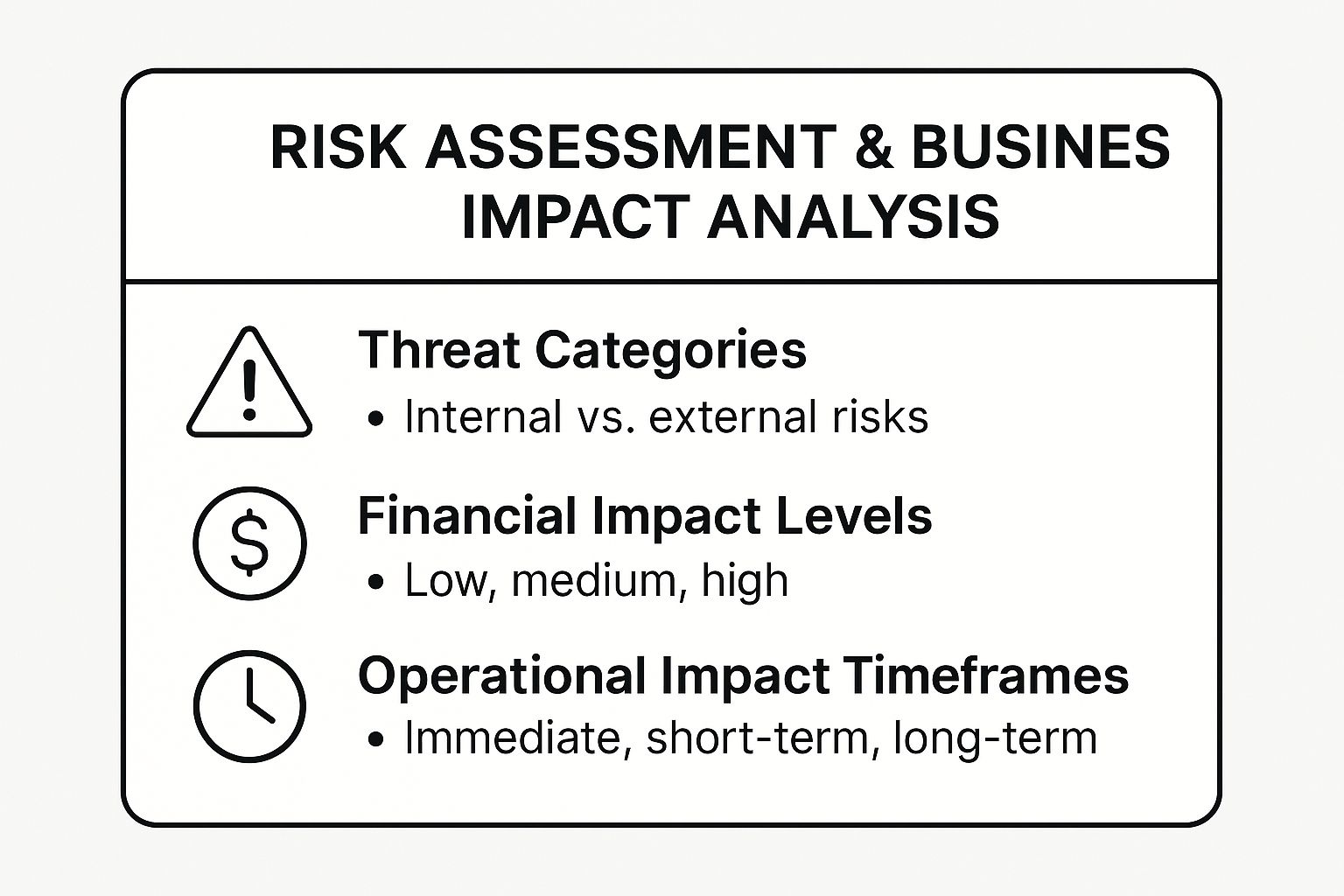
This quick reference visualizes how you can categorize threats and map their potential financial and operational impacts over time.
Actionable Implementation Tips
To effectively conduct your Risk Assessment and BIA, follow these proven strategies:
- Engage Cross-Functional Stakeholders: Involve leaders from IT, operations, finance, and legal. A CIO will understand system vulnerabilities, while a CFO can quantify the financial fallout of downtime. This collaborative approach ensures a holistic view of risks and impacts.
- Combine Quantitative and Qualitative Metrics: Don’t just focus on lost revenue (quantitative). Also, assess qualitative impacts like loss of customer data, brand reputation damage, and regulatory penalties. A minor financial disruption could trigger a major compliance breach.
- Utilize Scenario-Based Modeling: Go beyond simple checklists. Model complex, cascading failure scenarios. For example, what happens if a ransomware attack encrypts your primary SAN while your off-site backup replication is lagging? This tests the interplay between different risks.
- Establish a Review Cadence: Your risk landscape is not static. A BIA should be treated as a living document, updated at least annually or whenever significant architectural changes occur, such as a cloud migration, a major application deployment, or a data center consolidation.
2. Critical Business Functions Identification and Prioritization
Following the initial risk assessment, the next critical component of your business continuity planning checklist is to identify and prioritize your organization’s most essential functions from a technical perspective. This is not simply a list of what your company does; it’s a systematic ranking of applications and infrastructure based on their direct impact on operational viability and recovery. This step translates the abstract data from the BIA into a concrete recovery hierarchy, determining which systems and workflows must be restored first during a disruption.

The core output of this process includes defining the Recovery Time Objective (RTO) and Recovery Point Objective (RPO) for each application and its underlying infrastructure. The RTO dictates the maximum acceptable downtime before severe business impact occurs, while the RPO defines the maximum tolerable data loss. For an e-commerce platform’s transaction database, the RTO might be minutes with an RPO near zero, whereas an internal development server could have an RTO of several days.
Why This Is a Critical Step
Prioritization is where the strategic vision of business continuity meets tactical execution. It prevents resource waste on non-essential services during a crisis, focusing all efforts on what keeps the business operational. For instance, after a major outage, a SaaS provider must prioritize restoring core platform functionality and APIs over its internal marketing website to meet customer SLAs. This demonstrates the value of having pre-determined technical priorities.
This process, strongly advocated by frameworks from the Business Continuity Institute (BCI) and FEMA, ensures that technical recovery efforts are perfectly aligned with business needs. It moves the conversation beyond “get everything back online” to a more strategic “get Tier-0 and Tier-1 systems back online in the correct sequence,” which is vital when time and resources are scarce.
Actionable Implementation Tips
To effectively identify and prioritize your critical functions, implement these focused strategies:
- Involve Business Unit Leaders: IT cannot define business criticality in a vacuum. Engage department heads from sales, operations, finance, and customer support to gain an accurate understanding of which processes drive revenue and maintain customer satisfaction. Their input is essential for validating RTO and RPO values.
- Document the Rationale: Don’t just create a prioritized list; document why each function and its supporting applications received its ranking. This rationale is invaluable for future reviews and helps justify resource allocation for high-availability solutions or DR infrastructure for Tier-1 applications.
- Map Application and Infrastructure Dependencies: Map out the intricate web of dependencies. A customer portal (Tier-1) might rely on an authentication service (Tier-1) which, in turn, depends on a specific LDAP or Active Directory cluster (Tier-0). A failure to identify these underlying dependencies can render your prioritization model useless.
- Test Assumptions with Tabletop Exercises: Your prioritization is a hypothesis until tested. Run tabletop exercises simulating specific disasters (e.g., a data center fiber cut, a widespread cloud service outage). These exercises will quickly reveal flawed assumptions, such as underestimating the importance of a seemingly minor DNS service.
3. Emergency Response Procedures and Crisis Management
While a Business Impact Analysis prepares you for long-term recovery, your Emergency Response Procedures and Crisis Management plan dictates how you survive the first critical minutes and hours of a disaster. This component of your business continuity planning checklist is about immediate, decisive action. It outlines the step-by-step protocols for managing an incident as it unfolds, focusing on personnel safety, minimizing initial damage, and establishing a clear command structure to prevent chaos.
This is not a high-level strategy document; it is a tactical playbook. It defines who is in charge of the incident response (the Incident Commander), how technical teams communicate, and what immediate actions must be taken when a disruptive event—like a data center fire, a ransomware attack, or a physical security breach—occurs. The effectiveness of this initial response often determines the total impact of the crisis and the speed of subsequent recovery efforts.

Why This Is a Critical First Step
A well-defined emergency response plan transforms panic into process. In the absence of clear instructions, human nature can lead to confusion, conflicting orders, and costly mistakes. By establishing a framework like the Incident Command System (ICS), you create a standardized, scalable hierarchy for decision-making that works for any type of incident. This ensures that actions are coordinated, resources are deployed effectively, and every technical team member understands their role.
The classic case study is Johnson & Johnson’s response to the 1982 Tylenol crisis. The rapid, transparent, and decisive actions, guided by a strong crisis management framework, are still taught today as the gold standard. From a technical standpoint, this translates to having a clear protocol: isolate compromised systems, preserve forensic data, and activate the recovery plan without hesitation. A strong initial response is paramount.
Actionable Implementation Tips
To develop an effective emergency response plan, integrate these tactical strategies:
- Keep Procedures Simple and Actionable: During a high-stress event, complex flowcharts and lengthy paragraphs are useless. Use simple checklists, clear command language, and network diagrams. Actions should be intuitive and require minimal interpretation (e.g., “Isolate VLAN-10 from the core switch,” “Failover DNS to secondary provider”).
- Establish Out-of-Band Communication Channels: Relying on a single communication method (e.g., corporate email) is a critical failure point. Your plan must include primary, secondary, and tertiary channels, such as mass SMS alerts, a dedicated conference bridge, a status page hosted on independent infrastructure, and even satellite phones for a total communications blackout.
- Train and Drill Regularly: A plan on paper is not a capability. Conduct regular drills and tabletop exercises for various scenarios—from active shooter situations to data center fires. These drills build muscle memory and expose weaknesses in your plan before a real crisis does. They are also crucial for improving the situational awareness of your response teams.
- Clearly Define Roles and Responsibilities: Every employee should know the basic safety procedures (e.g., evacuation routes), while a specific Crisis Management Team (CMT) must have clearly delineated roles. Define who is authorized to make technical changes, who coordinates with telecom providers, and who manages technical triage.
4. IT Disaster Recovery and Data Backup Systems
While a Business Impact Analysis (BIA) tells you what to protect, your IT Disaster Recovery (DR) and Data Backup strategy dictates how you protect it. This component of your business continuity planning checklist is the technical engine of resilience, focused on the comprehensive recovery strategies that ensure critical IT systems, applications, and data can be restored within predefined RTOs and RPOs. It moves beyond theory into the practical, hands-on procedures for restoring the technological backbone of your organization.

This involves designing and implementing robust backup and recovery procedures, establishing alternative processing sites (hot, warm, or cold), and defining data replication strategies. For instance, Salesforce leverages real-time, asynchronous data replication across geographically dispersed data centers, ensuring that a regional failure doesn’t compromise data integrity or service availability. Similarly, Capital One’s cloud-native DR strategy uses Infrastructure as Code (IaC) and the elasticity of AWS to achieve rapid, scalable recovery capabilities.
Why This Is a Critical Technical Step
In today’s digital-first environment, operational uptime is synonymous with IT uptime. A failure in your DR and backup systems directly translates to revenue loss, SLA penalties, and severe reputational harm. A well-architected DR plan provides a structured, predictable response to chaos, transforming a potential catastrophe into a manageable incident with minimal data loss.
Modern DR planning must also account for an increasingly distributed attack surface. When planning for IT disaster recovery and data backup, it’s crucial to extend security protocols to encompass the unique cybersecurity considerations for remote workers, ensuring endpoints are secure and backhauling traffic through a secure network perimeter. Enhanced network resilience can be achieved through advanced solutions, and you can learn more about business continuity with SD-WAN.
Actionable Implementation Tips
To develop a formidable IT DR and backup system, focus on these technical best practices:
- Implement the 3-2-1-1-0 Backup Rule: This modern evolution of the classic rule dictates maintaining 3 copies of your data, on 2 different media types, with 1 copy stored off-site, 1 copy that is offline (air-gapped) or immutable, and 0 errors after recovery verification. This provides layered protection against everything from hardware failure to ransomware.
- Automate Recovery Processes: Leverage orchestration tools (e.g., VMware Site Recovery Manager, Azure Site Recovery) and Infrastructure as Code (IaC) scripts to automate failover and failback procedures. Automation minimizes recovery time objectives (RTOs) and drastically reduces the risk of human error during high-stress recovery scenarios.
- Conduct Regular, Full-Scale DR Testing: Go beyond simple backup integrity checks. Perform full-scale simulations that involve failing over production workloads to your secondary site and running them for a designated period. This is the only way to truly validate your RTO/RPO targets and uncover hidden dependencies.
- Leverage Hybrid and Multi-Cloud Solutions: A hybrid approach allows you to use on-premises infrastructure for low-latency recovery of tier-0 applications while leveraging the cost-effective scalability of the public cloud for less critical workloads. This optimizes for both performance and budget.
5. Communication Plans and Stakeholder Management
During a crisis, technology and operational recovery are only half the battle. A critical component of any effective business continuity planning checklist is a well-defined Communication and Stakeholder Management Plan. How your technical teams communicate during a disruption directly impacts customer trust, internal morale, and brand reputation. A clear, proactive communication strategy prevents misinformation, manages expectations, and demonstrates control, turning a potential disaster into a manageable event.
This plan is not something to be improvised during an incident. It must be a pre-built playbook detailing who communicates (e.g., NOC, support team, executive leadership), what technical details they share, and through which channels they say it. It involves mapping every stakeholder group, from internal IT staff and end-users to external partners and regulators, and crafting messages tailored to their specific technical understanding and concerns. As communications experts at Edelman and PRSA emphasize, transparency and speed are paramount.
Why This Is a Critical Step
Without a structured communication plan, a vacuum of information is created, which will inevitably be filled with speculation, rumors, and panic. This can cause more damage than the initial disruption itself. For instance, a system outage that is poorly communicated can lead to an avalanche of redundant support tickets, social media backlash, and negative press, even if the technical recovery is swift.
A robust plan ensures a single source of truth and a coordinated response. For example, during major service outages, cloud providers like AWS excel by using their public status dashboards to provide timely, technically specific updates on the root cause, impacted services, and mitigation efforts. This proactive communication is a core element of effective crisis management and is essential for maintaining stakeholder confidence.
Actionable Implementation Tips
To develop a communication plan that holds up under pressure, follow these proven strategies:
- Segment Stakeholders and Pre-draft Messages: Identify all key groups: internal (IT staff, leadership), external (customers, partners, suppliers), and regulatory/media. Draft templated messages for various scenarios (e.g., cyberattack, data center outage, cloud provider failure) for each group. This saves critical time and prevents rushed, error-prone communications during a real event.
- Establish a Clear Communication Hierarchy: Define who is authorized to speak on behalf of the company and establish a clear approval workflow for all external messages. This hierarchy should include technical leads who can provide accurate status updates (e.g., “We have identified the root cause as a BGP routing issue”) to the communications team, ensuring messages are both timely and factually correct.
- Utilize Redundant Communication Channels: Your primary channels (e.g., email, corporate website) may be affected by the disruption. Your plan must include multiple, resilient communication methods like a dedicated status page (e.g., Atlassian Statuspage), SMS alert systems, social media accounts, and an out-of-band conference bridge.
- Practice Technical Transparency and Honesty: Be as transparent as possible without compromising security. Acknowledge the issue, explain the steps being taken to resolve it, and provide realistic ETAs for updates. Zoom’s proactive communication about its security vulnerabilities during its rapid growth in 2020 is a prime example of addressing issues head-on to rebuild user trust.
6. Alternative Work Arrangements and Remote Operations
A critical component of any modern business continuity planning checklist is the development of robust alternative work arrangements and remote operations capabilities. This strategy addresses disruptions that prevent access to primary business locations, such as natural disasters, public health crises, or localized utility failures. It’s about ensuring your workforce can remain productive, secure, and connected from anywhere, transforming a potential operational standstill into a manageable transition. This involves more than just handing out laptops; it requires a holistic ecosystem of technology, policy, and security controls.
The goal is to decouple critical business functions from a physical office. By building a resilient remote access infrastructure—including VPNs, VDI, and SASE—you empower employees to perform their essential duties without interruption. This proactive approach has been validated by companies like GitLab and Automattic, which have built highly successful, fully remote operational frameworks from the ground up, proving that high performance is not tied to a specific building.
Why This Is a Critical Step
The COVID-19 pandemic served as a global stress test, revealing that organizations without pre-existing, scalable remote access plans faced significant operational chaos and security vulnerabilities. Establishing these arrangements in advance moves your organization from a reactive, crisis-driven scramble to a controlled, strategic response. It ensures that when a disruption hits, the activation of remote work is a planned procedure, not a panicked improvisation that overloads your VPN concentrators.
This preparedness also provides a significant competitive advantage. An organization that can seamlessly switch to remote operations will experience less downtime, retain customer trust, and maintain market momentum while competitors struggle. It also expands your talent pool by allowing you to hire skilled individuals regardless of their geographical location, a long-term strategic benefit.
Actionable Implementation Tips
To effectively implement alternative work arrangements, focus on these critical actions:
- Invest in Robust Cloud-Based Platforms: Deploy a suite of secure, scalable cloud services for communication (e.g., Slack, Microsoft Teams), project management (e.g., Asana, Jira), and core business applications (e.g., Salesforce, Office 365). This ensures universal access to essential tools from any location.
- Provide Comprehensive Remote Work Security Training: Educate employees on the specific cybersecurity risks associated with remote work, including phishing attacks targeting home networks, secure Wi-Fi usage, and the importance of using a VPN. Mandate multi-factor authentication (MFA) on all company accounts and implement Zero Trust Network Access (ZTNA) principles.
- Establish Clear Performance and Communication Protocols: Define explicit expectations for remote work, including core availability hours, communication response times, and methods for reporting progress. This prevents ambiguity and ensures accountability. For an in-depth look at empowering remote teams, you can learn more about real-world success stories.
- Regularly Assess and Upgrade Remote Technology: Technology is not a “set it and forget it” solution. Continuously load-test your remote access infrastructure, from VPN concentrator capacity and VDI session brokers to the reliability of your collaboration tools, and upgrade as needed to prevent bottlenecks during a real event.
7. Supply Chain and Vendor Management Continuity
A modern organization is an ecosystem, not an island. A critical component of any effective business continuity planning checklist involves extending resilience beyond your own four walls to your supply chain and third-party vendors. A disruption to a single critical supplier, whether for hardware, software-as-a-service (SaaS) platforms, or managed IT services, can bring your operations to a standstill just as effectively as an internal system failure. Supply chain continuity planning mitigates these external dependencies.
This process involves systematically identifying, assessing, and managing risks associated with your entire network of suppliers and partners. It moves beyond simple procurement to strategic vendor risk management, ensuring that your key partners have their own robust continuity plans in place. As technical dependencies on third-party APIs and cloud services grow, this step has transitioned from a best practice to an absolute necessity for survival.
Why This Is a Critical Step
Your organization’s resilience is only as strong as its weakest link, and often that link is a third-party vendor. The COVID-19 pandemic and subsequent semiconductor shortages starkly illustrated how dependencies on single-source or single-region suppliers could cripple even the largest enterprises. For IT leaders, this risk extends to critical cloud providers, CDN operators, and authentication services.
Integrating supply chain continuity into your BCP ensures you are not blindsided by a partner’s outage. It aligns your operational resilience with the realities of a deeply interconnected business landscape. For example, Toyota’s legendary supply chain management, which emphasizes deep supplier relationships and visibility, allowed it to recover from events like the 2011 Japan earthquake far faster than its competitors by quickly identifying and resolving production chokepoints.
Actionable Implementation Tips
To build a resilient supply chain and vendor management program, implement these proven strategies:
- Map Your Entire Supply Chain: Go beyond your direct (Tier 1) suppliers. Work to identify their critical dependencies (Tier 2 and 3 suppliers). A disruption to a key component manufacturer for your primary hardware vendor can have a direct impact on you. Use supply chain mapping software or partner with logistics experts to gain this crucial visibility.
- Include BCP Clauses in Vendor Contracts: Make business continuity a contractual obligation. Your Master Service Agreements (MSAs) and Statements of Work (SOWs) should require key vendors to maintain an active BCP, define specific RTOs/RPOs for their service, and grant you the right to audit their plans or review their SOC 2 Type 2 reports.
- Diversify and Establish Alternatives: Avoid single points of failure. For critical hardware or services, identify and pre-qualify alternative suppliers in different geographic regions. For critical SaaS applications, investigate potential alternative platforms or have a plan for manual workarounds or degraded functionality.
- Continuously Assess Vendor Health: Regularly monitor the financial stability, cybersecurity posture, and operational health of your critical vendors. Use third-party risk intelligence platforms and conduct periodic reviews to catch warning signs, such as a cybersecurity breach or high engineering staff turnover, before they escalate into a service disruption.
Business Continuity Planning: 7-Point Checklist Comparison
| Item | Implementation Complexity | Resource Requirements | Expected Outcomes | Ideal Use Cases | Key Advantages |
|---|---|---|---|---|---|
| Risk Assessment and Business Impact Analysis (BIA) | High | Time-consuming, requires expertise | Data-driven risk prioritization and impact quantification | Identifying vulnerabilities, prioritizing recovery efforts | Increases organizational risk awareness, supports cost-benefit decisions |
| Critical Business Functions Identification and Prioritization | Moderate | Requires cross-department collaboration | Clear prioritization of recovery efforts with defined RTOs/RPOs | Focused recovery planning, resource optimization | Provides guidance under pressure, aligns organization on priorities |
| Emergency Response Procedures and Crisis Management | Moderate to high | Training intensive, needs clear protocols | Rapid, coordinated response minimizing impact and ensuring safety | Immediate incident response, personnel safety | Reduces confusion, ensures accountability, protects lives |
| IT Disaster Recovery and Data Backup Systems | High | Expensive, technical expertise required | Fast restoration of IT systems and data with minimized downtime | IT system failure recovery, cyber incident response | Minimizes data loss, scalable cloud options, geographic dispersion |
| Communication Plans and Stakeholder Management | Moderate | Requires dedicated communication resources | Maintains trust and prevents misinformation during disruptions | Managing internal/external communications in crises | Ensures consistent messaging, reduces chaos, maintains confidence |
| Alternative Work Arrangements and Remote Operations | Moderate | Investment in technology and security | Business continuity with flexible workforce operations | Remote work enablement, location-restricted scenarios | Enhances workforce flexibility, reduces location dependency |
| Supply Chain and Vendor Management Continuity | High | Complex supplier management and monitoring | Continuity of critical supplies and rapid supplier switching | Supply chain disruptions and vendor risk management | Reduces single points of failure, improves supply resilience |
Transforming Your Checklist into a Living, Breathing BCP
Navigating through a comprehensive business continuity planning checklist is a formidable first step. You’ve identified critical applications, analyzed potential impacts, and outlined response strategies. This structured approach, from risk assessment to supply chain management, provides the architectural blueprint for resilience. However, the true measure of a business continuity plan (BCP) isn’t in its creation, but in its execution and evolution. The document itself is merely a snapshot in time; its value is realized when it becomes a dynamic, integrated part of your organization’s operational fabric.
The checklist items we’ve explored, including emergency response, IT disaster recovery, and communication protocols, are not isolated modules. They are interconnected systems that must work in concert during a crisis. Think of it as moving from a theoretical schematic to a fully functional, pressure-tested machine. The real work begins now: transforming this static checklist into a living, breathing BCP that your technical teams trust and can execute flawlessly under duress.
From Static Document to Dynamic Framework
The most common failure point for any BCP is neglect. A plan developed and then stored on a file share is almost as useless as no plan at all. To avoid this, you must foster a culture of preparedness where business continuity is not an annual exercise but a continuous operational discipline.
Here are the actionable next steps to embed your BCP into your organization’s DNA:
- Schedule and Socialize a Testing Cadence: Move immediately from planning to testing. Schedule your first tabletop exercise within the next quarter. Follow up with more intensive functional drills and full-scale simulations over the next 12-18 months. Socialize this schedule with all stakeholders so it becomes an expected and prioritized activity.
- Establish Clear Ownership and Triggers for Updates: Assign a BCP “owner” or committee responsible for its maintenance. Define specific triggers for review, such as a new major technology deployment, a significant change in vendors, a shift in business strategy, or, most importantly, after any real-world incident or near-miss.
- Integrate BCP into Employee Onboarding and Training: A plan is only as strong as the people who execute it. Incorporate BCP roles and responsibilities into new hire orientation and regular departmental training. Every team member, from the help desk to the network engineering team, must understand their specific role during a disruption.
Key Insight: A successful BCP isn’t a “break glass in case of emergency” document. It should be a familiar playbook that informs daily operational decisions, risk management discussions, and technology architecture choices. Its principles should guide how you build and maintain resilient systems from the ground up.
The Critical Role of Proactive Network Resilience
A recurring theme throughout our business continuity planning checklist is the dependency on connectivity. Your communication plan, remote work strategy, and IT disaster recovery all hinge on one fundamental element: a stable and reliable network. In today’s digital-first environment, waiting for a network outage to trigger a recovery process is a reactive posture that guarantees downtime and revenue loss.
This is where the concept of a “living” BCP becomes tangible. Instead of just planning for failure, you build a system that actively prevents it. This is particularly crucial for your Wide Area Network (WAN), the lifeline connecting your users, data centers, and cloud applications.
Modern solutions allow you to move beyond a simple active/passive failover model, where one ISP connection takes over after another has already failed. Technologies like Software-Defined WAN (SD-WAN) with WAN bonding capabilities fundamentally change the game. By intelligently bonding multiple internet connections (e.g., fiber, cable, 4G/5G LTE, satellite) into a single, cohesive virtual pipe, you create a network that is resilient by design. If one link experiences latency, jitter, or a complete outage, traffic is automatically and seamlessly rerouted over the other active links without dropping the session. This ensures critical applications remain online, VoIP calls don’t drop, and data continues to flow, making your network uptime a proactive, always-on reality rather than a reactive recovery goal.
By investing in such infrastructure, you are not just checking a box on your BCP; you are building a foundational layer of continuity that makes many potential disruptions completely transparent to your end-users and customers. This is the ultimate goal: to transform your plan from a document of recovery into a platform for uninterrupted business operations.
Ready to build proactive network resilience directly into your business continuity plan? Mushroom Networks Inc. provides industry-leading SD-WAN and WAN bonding solutions that ensure your critical applications are always on. Discover how our technology can transform your BCP from a reactive document into an always-on reality at Mushroom Networks Inc..