For IT professionals, network security isn’t a single product or a checkbox on a compliance form. It’s a strategic, multi-layered discipline. Mastering these fundamentals is what differentiates a fragile, reactive network from a resilient infrastructure—one that not only enables business operations but actively defends critical data assets.
What Are Network Security Fundamentals?

Effective network security is not analogous to a simple lock on a door. A better analogy is the comprehensive security system of a corporate headquarters, integrating physical barriers, electronic access control, human guards, and hardened vaults. In the digital realm, this translates to a defense-in-depth strategy engineered to protect the entire IT infrastructure.
At its core, understanding network security fundamentals requires moving beyond a simple checklist of vendor solutions. It involves cultivating a strategic mindset focused on defending digital assets against an evolving threat landscape. The entire practice is built on a logical framework that ensures every technical security decision aligns with core business objectives like uptime, data integrity, and operational continuity.
The Guiding Principles of Network Security
For those of us managing IT infrastructure, the “why” behind our security controls is as critical as the “how.” The discipline is architected around three core tenets, formally known as the CIA Triad. This framework provides the logic for every firewall rule, access policy, and security technology you will ever configure.
The CIA Triad serves as the foundational logic for all security decisions. It ensures that technical implementations are not arbitrary but are directly mapped to the fundamental objectives of information protection.
These three pillars dictate the ultimate goals of any effective security program:
- Confidentiality: This principle ensures data is accessible only to authorized entities and is protected from unauthorized disclosure. Functionally, this is about enforcing access control and preventing data exfiltration.
- Integrity: This pillar guarantees that data is authentic, accurate, and has not been altered by unauthorized parties. It is the assurance of data trustworthiness, preventing unauthorized modification or corruption.
- Availability: This principle ensures that systems, networks, and data are operational and accessible to legitimate users upon demand. It is the commitment to maintaining service uptime and resilience against disruption.
By architecting security through this lens, IT teams can build a network that is not just defended, but demonstrably resilient. Every policy and hardware component serves one of these three objectives, creating a cohesive and purposeful security posture that supports the entire organization.
The CIA Triad: The Cornerstone of Security Architecture
Every security policy implemented, every firewall rule configured, and every tool deployed ultimately serves one of three core objectives. This trio of principles, known as the CIA Triad, forms the bedrock of network security. For IT professionals, a deep understanding of this framework is non-negotiable, as it provides the core logic behind every defensive action.
The CIA Triad is the constant reference point—a technical North Star—that ensures every decision is purposeful and aligned with protecting mission-critical assets. It is composed of three pillars: Confidentiality, Integrity, and Availability.
Confidentiality: Enforcing Secrecy
Confidentiality is the principle of preventing unauthorized disclosure of information. It ensures that data, communications, and systems are shielded from unauthorized access. This is the first line of defense, dedicated to enforcing need-to-know access controls.
A functional analogy is a sealed diplomatic pouch. Only the intended recipient has the authority to break the seal and view the contents. In the digital realm, this translates into tangible security controls designed to prevent data theft and unauthorized observation.
Here are technical implementations of confidentiality:
- Encryption: Utilizing strong cryptographic algorithms for data both in transit (e.g., TLS, IPsec) and at rest (e.g., AES-256).
- Access Control Lists (ACLs): Implementing granular permissions that dictate which subjects (users, services) can access specific objects (files, network resources).
- Authentication Mechanisms: Deploying robust identity verification protocols, such as multi-factor authentication (MFA), to validate user or service identity before granting access.
A breach of confidentiality occurs when an attacker exfiltrates a customer database or an employee gains access to sensitive HR records beyond their authorization.
Integrity: Ensuring Trustworthiness
The second pillar, Integrity, guarantees that data is authentic, accurate, and has not been subjected to unauthorized modification. While confidentiality is about who can access data, integrity is about trusting that the data being accessed is correct and unaltered.
Consider a tamper-evident seal on a server chassis or a cryptographic hash of a forensic image. Its purpose is to provide a verifiable guarantee that the contents have not been meddled with. That is precisely the role integrity plays in a network.
Integrity is the assurance that a file, system configuration, or data packet is exactly what it purports to be. Without it, the data driving business decisions is unreliable.
This principle is critical for preventing sabotage and maintaining operational reliability. For IT teams, this means protecting firmware from malicious updates or ensuring a financial transaction record cannot be covertly modified. Technologies like cryptographic checksums (e.g., SHA-256), digital signatures, and version control systems are all designed to enforce data integrity.
Availability: Maintaining Operational Uptime
Finally, Availability ensures that networks, systems, and data are accessible and operational for legitimate users when needed. This is the “always-on” guarantee that the infrastructure can withstand disruptions and continue to serve the business.
This pillar is arguably the most visible to end-users. When availability is compromised, services are disrupted, productivity ceases, and the business incurs financial losses. The classic attack against availability is a Distributed Denial-of-Service (DDoS) attack, where a target is overwhelmed with malicious traffic, rendering it unable to respond to legitimate requests. Building resilient systems with redundancy, load balancing, and failover capabilities is the primary defense. You can discover more about the connection between modern networking solutions and cybersecurity protections in our detailed guide.
The shift to cloud computing and distributed workforces has amplified the challenge of protecting the CIA Triad, driving massive investment in security. The global network security market was valued at USD 24.55 billion in 2024 and is projected to skyrocket to USD 72.97 billion by 2032—a clear indicator of the criticality of these fundamentals. Every security measure, from firewalls to advanced SD-WAN deployments, is ultimately designed to uphold one or more of these foundational principles.
Building Your Defensive Toolkit
Now that we’ve established the core principles of the CIA Triad, let’s translate theory into practice. It’s time to discuss the technologies used to build your defensive posture. A functional understanding of network security requires knowing which tools to deploy and for what specific purpose. These are the building blocks of any modern defense, each playing a distinct but essential role in protecting digital assets.
This is analogous to assembling a specialized security detail. You wouldn’t rely on a single guard at the main entrance. You would deploy perimeter guards, surveillance systems, internal patrols, and secure transport for high-value assets. A robust network defense is no different—it layers multiple technologies to create a security posture that is difficult to compromise.
Firewalls: The Network Gatekeepers
The first and most fundamental tool in any security arsenal is the firewall. A firewall functions as your network’s gatekeeper, positioned at the perimeter to inspect all ingress and egress traffic. Its primary function is to enforce access control policies, determining which traffic is permitted and which is denied.
This dashboard provides a view into a firewall’s management interface, where these front-line defenses are monitored and configured.
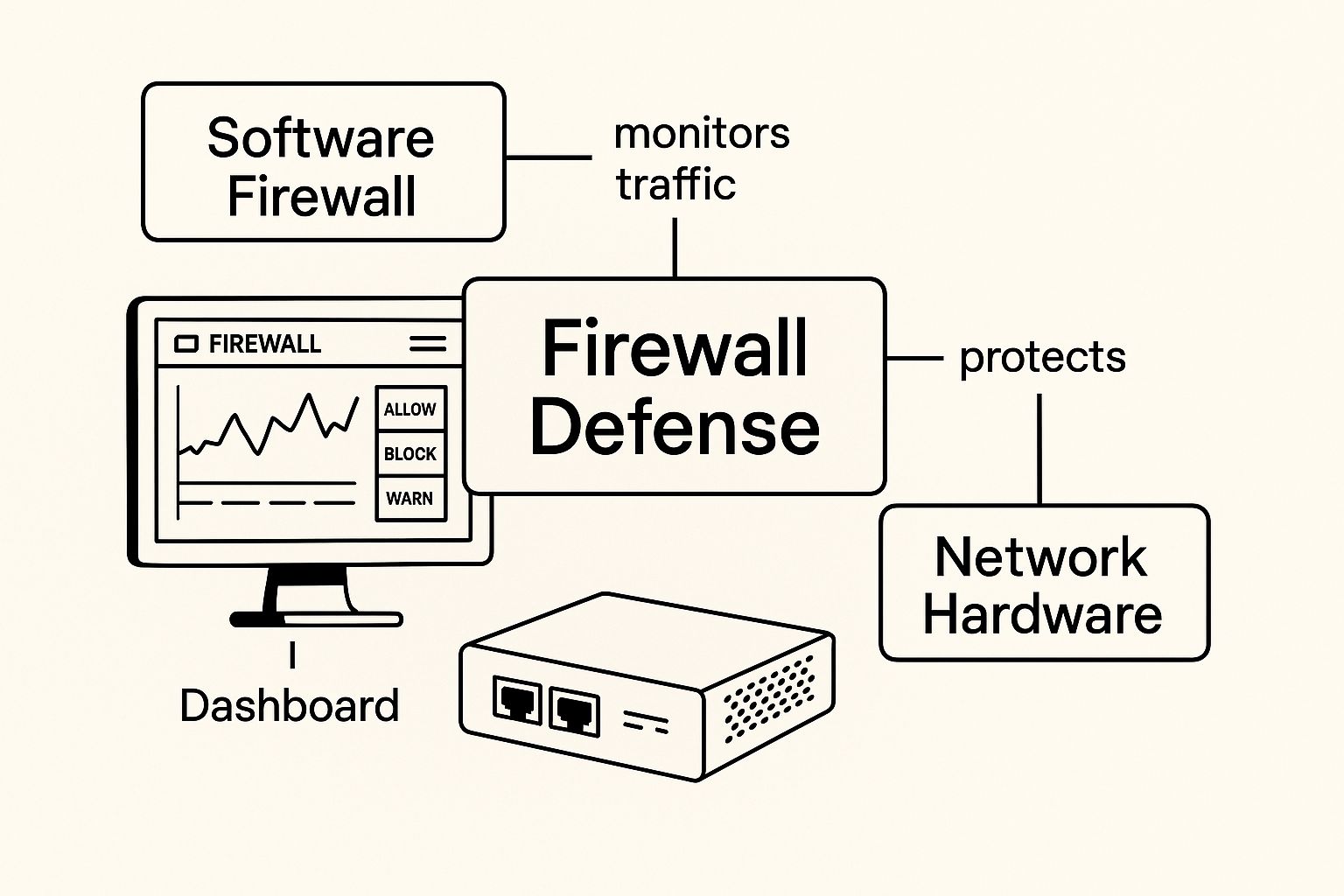
As you can see, the objective is to filter traffic before it can reach critical internal systems. It is your first line of defense.
Firewalls are generally categorized into two main types:
- Stateless Firewalls: These packet-filtering firewalls inspect packets in isolation. Decisions are based on static information in the packet headers, like source/destination IP addresses and ports. They are fast but lack contextual awareness.
- Stateful Firewalls: These are the standard for modern network security. A stateful firewall maintains a state table to track the status of all active network connections. By understanding the context of a traffic flow, it is far more effective at detecting and blocking malicious traffic that might otherwise appear legitimate.
Most modern network hardware, including multi-WAN routers, integrates a sophisticated stateful firewall, providing essential protection at the network edge.
VPNs: Encrypted Tunnels for Secure Transit
While firewalls protect the perimeter, a Virtual Private Network (VPN) secures data in transit. A VPN establishes a secure, encrypted tunnel over a public network (like the internet), creating a private, confidential channel for data transmission.
This is indispensable for two primary use cases:
- Remote Access: When an employee connects from an untrusted network, their traffic traverses public infrastructure. A remote access VPN encrypts their connection back to the corporate network, preventing eavesdropping or data interception.
- Site-to-Site Connectivity: For organizations with multiple locations, a site-to-site VPN securely links the networks of different branches over the internet. This allows them to share resources as if they were on a single LAN, but without the cost of a dedicated private WAN circuit.
IDS and IPS: The Active Security Patrol
If the firewall is your gatekeeper, then Intrusion Detection and Prevention Systems are the active security patrol. They provide a more dynamic defense, constantly analyzing network traffic for signatures of known attacks or anomalous behavior.
An Intrusion Detection System (IDS) functions like a surveillance system; it detects a potential threat and generates an alert. An Intrusion Prevention System (IPS) is the security guard who not only detects the threat but is positioned in-line to actively block it.
These systems operate by matching traffic against a database of attack signatures or by establishing a baseline of normal network behavior and flagging significant deviations. They can be deployed as:
- Host-based (HIDS/HIPS): Software agents installed on individual endpoints (e.g., servers, workstations), monitoring only the activity on that specific host.
- Network-based (NIDS/NIPS): A dedicated appliance on the network that inspects all traffic passing through it, providing broader visibility.
To maximize the effectiveness of these systems, setting up robust security notifications is non-negotiable. Real-time alerting is critical for timely incident response.
The real power comes from integrating these tools. A firewall may block traffic from a known-bad IP, an IPS may stop a zero-day exploit that bypasses the firewall, and a VPN ensures the data was encrypted throughout. Layering defenses in this manner is the only way to build a truly resilient network. Even as threats evolve, you can shield your business from AI-powered cyber attacks by adopting modern, integrated security strategies where the weakness of one control is compensated by the strength of another.
Advanced Strategies for Containing Threats
Having the right defensive tools is crucial, but a truly resilient network operates under a stark assumption: a breach is a matter of if, not when. The real goal isn’t just to keep attackers out; it’s to ensure that when one inevitably slips through, the damage is tightly contained. This is where proactive strategies that limit an attacker’s blast radius become a cornerstone of modern network security.
An attacker who gains a foothold on a single workstation should never have free rein to waltz over to critical servers or sensitive databases. This is the moment you shift from a reactive defense to a resilient architecture. By designing your network to be resilient from the start, you dramatically shrink the potential fallout of any single security failure.
Architecting for Resilience with Network Segmentation
Think of your network like a modern submarine. If the hull is breached in one section, watertight compartments slam shut, isolating the flood and preventing the entire vessel from sinking. Network Segmentation applies this exact same life-saving logic to your digital infrastructure. It’s the practice of carving up a large network into smaller, isolated sub-networks, or segments.
This creates internal boundaries that are a nightmare for an attacker to cross. If one segment is compromised—let’s say, the public Wi-Fi network—the breach is quarantined. The attacker is stuck, unable to easily move laterally to more critical areas like the finance department’s servers or the development environment.
Network segmentation transforms a flat, vulnerable network into a series of defensible islands. It forces an attacker to break through multiple, independent security checkpoints, making their job significantly harder and buying your security team precious time to respond.
This strategy is foundational for containing threats and represents a clear evolution beyond basic perimeter defense.
Practical Methods for Segmentation
Implementing segmentation isn’t just a theoretical exercise; it involves specific technologies that build and enforce these digital walls. The two most common approaches you’ll encounter are VLANs and the more granular micro-segmentation.
-
Virtual LANs (VLANs): A long-standing and reliable method, VLANs logically divide a single physical network into multiple, distinct broadcast domains. You can, for instance, create separate VLANs for HR, Engineering, and Guest Wi-Fi, even if all their devices plug into the same physical switches. Traffic from one VLAN simply cannot cross into another without first passing through a router or firewall, which acts as the checkpoint.
-
Micro-segmentation: This is a more modern and surgical approach, often deployed in data centers and cloud environments. Instead of segmenting large groups of users or departments, micro-segmentation can isolate individual workloads or even single applications from each other. Think of it as putting a dedicated, software-defined firewall around every single server, ensuring that two machines can only communicate if an explicit policy allows it.
Choosing between them really comes down to your environment. VLANs are excellent for structuring corporate office networks, while micro-segmentation offers the precision needed to secure complex, dynamic data center and cloud deployments where workloads are constantly spinning up and down.
Enforcing Control with the Principle of Least Privilege
Once your network is segmented, the next critical step is controlling who and what can move between those segments. This is governed by one of the most important ideas in all of security: the Principle of Least Privilege (PoLP). This principle is simple but powerful: a user, device, or application should only be granted the absolute minimum level of access required to do its job—and absolutely nothing more.
For example, an HR application server has no business communicating with the source code repository in the development segment. A marketing employee’s laptop has no legitimate reason to access the command-line interface of a production database server. By enforcing least privilege, you eliminate countless potential attack vectors by default. This transforms your access control from a permissive “allow all, deny some” model to a much more secure “deny all, allow some” posture.
This intense focus on proactive security is driving significant market growth. Globally, the network security sector was valued at USD 40.04 billion in 2024 and is projected to hit USD 62.10 billion by 2033. This expansion is fueled by the deep integration of digital technologies everywhere, from smartphones to complex industrial systems, all demanding robust protection. As you can read in the full research about these network security market trends, emerging technologies like edge computing and widespread IoT adoption only amplify this need by decentralizing data and expanding the attack surface.
By combining segmentation with strict access controls, you create a network that is inherently resilient. It’s an architecture where a breach becomes merely an incident, not a catastrophe.
From Theory to Practice: A Security Checklist

Understanding concepts like the CIA Triad, firewalls, and segmentation is one thing. Operationalizing them is another. Effective security isn’t just theoretical knowledge; it’s forged through consistent, disciplined processes.
This is where implementation matters. A strong security posture is not a one-time project but a continuous cycle of implementation, validation, and refinement. To bridge the gap between theory and practice, here is an actionable roadmap for translating high-level principles into standard operating procedures. Each point directly reinforces the network security fundamentals we have discussed.
Implement Disciplined Patch Management
Unpatched systems are a primary vector for attackers. A rigorous patch management process is your most critical defense against known exploits. This extends beyond operating systems to include firmware for all network devices (routers, switches, firewalls) and every application running on the network.
Prioritization is key. Use metrics like the Common Vulnerability Scoring System (CVSS) score to address the highest-risk vulnerabilities first. A critical remote code execution (RCE) vulnerability on a public-facing server takes precedence over a low-risk bug in an internal-only application. Automating scanning and deployment wherever possible is essential for ensuring comprehensive coverage and directly upholding the Integrity and Availability of your systems.
Develop and Rehearse an Incident Response Plan
When a breach occurs—and it is a matter of when, not if—an ad-hoc response can cause more damage than the initial attack. A documented, well-rehearsed Incident Response (IR) plan enables the team to act decisively and effectively under pressure.
Your IR plan must clearly define:
- Roles and Responsibilities: Who is the incident commander? Who performs technical analysis, and who manages stakeholder communications?
- Phases of Response: Outline clear, actionable steps for each phase: Identification, Containment, Eradication, and Recovery.
- Communication Protocols: Establish how information is shared internally and the specific triggers for escalating to legal or executive leadership.
An incident response plan is not just about resolving the immediate technical issue. It’s about minimizing operational and financial impact, reducing recovery time, and, most importantly, leveraging lessons learned to harden defenses against future attacks.
Conduct Continuous Security Awareness Training
Your employees can be either your greatest vulnerability or your first line of defense. The outcome is determined by training. This is not a once-a-year compliance exercise.
Effective security awareness involves continuous, engaging training and regular simulated phishing campaigns to maintain a high level of security consciousness. This approach transforms personnel from a potential liability into a proactive human sensor network. For a deeper look, you can check out our guide on comprehensive network security solutions for more strategies to protect your organization.
Got Questions? We’ve Got Answers
Even with a solid theoretical foundation, implementing network security in a live production environment always raises practical questions. Here are answers to some of the most common queries from IT professionals.
What Is the Real Difference Between an IDS and an IPS?
While an Intrusion Detection System (IDS) and an Intrusion Prevention System (IPS) both analyze traffic for malicious activity, they have fundamentally different operational roles. An IDS operates in a passive, out-of-band mode. It is analogous to a surveillance camera that records an event and generates an alert. It informs you that a potential security event has occurred but does not intervene.
An IPS, conversely, is deployed in-line with the traffic flow. It functions as an active enforcement point. It not only detects the threat but has the capability to drop the malicious packets before they reach their intended target. An IPS doesn’t just report on a potential problem; it actively attempts to prevent it.
How Does Network Segmentation Actually Stop an Attacker?
Network segmentation contains threats by limiting lateral movement. In a flat, unsegmented network, an attacker who compromises a single endpoint can often move freely across the entire network, accessing sensitive resources at will.
Segmentation creates internal security boundaries, typically using VLANs and firewall rules. For example, you can create separate segments for guest wireless, corporate workstations, and production servers. If an attacker compromises a laptop on the guest segment, they are isolated within that zone. To move to the server segment, they must breach the firewall that sits between the segments—a much more difficult and “noisy” action that is more likely to be detected.
By implementing these internal chokepoints, segmentation dramatically reduces an attacker’s blast radius. It transforms a potential network-wide catastrophe into a contained, manageable security incident.
Why Should I Care About the CIA Triad for Firewall Configuration?
The CIA Triad—Confidentiality, Integrity, and Availability—provides the strategic rationale for your firewall rule base. Without it, rule creation becomes a purely tactical exercise without a clear objective.
For instance:
- When you create a rule to deny all traffic to a database server except from a specific application server, you are enforcing Confidentiality.
- When you configure rules to drop malformed packets or block traffic that violates protocol standards, you are protecting the Integrity of target systems.
- When you implement Quality of Service (QoS) policies to prioritize critical traffic like VoIP during a DDoS attack, you are working to ensure Availability.
The triad provides the strategic framework for your tactical configurations, ensuring every rule has a purpose.
At Mushroom Networks Inc., we believe robust security shouldn’t be an afterthought. That’s why we embed powerful security features like stateful firewalls and advanced QoS capabilities directly into our multi-WAN devices. Our solutions provide a secure and resilient foundation for your network, right at the edge where it matters most. Learn how our broadband bonding technology can simplify and strengthen your network security.