A software-defined wide area network (SD-WAN) is a virtualized WAN architecture that abstracts transport services—including MPLS, broadband internet, and LTE—into a unified pool of network capacity. It leverages a centralized control function to intelligently steer traffic based on application-aware policies, delivering increased agility and reduced TCO.
While a traditional WAN architecture resembles a rigid hub-and-spoke model where traffic is backhauled to a central data center for policy enforcement, SD-WAN operates as a distributed, transport-agnostic overlay. It utilizes real-time telemetry on path performance (latency, jitter, packet loss) to dynamically select the optimal route for specific application flows, directly from the branch.
For IT professionals, this means decoupling network software services from the underlying physical hardware. The result is an agile, cost-effective, and high-performance network fabric capable of meeting the demands of cloud-based applications and a distributed workforce.
A Practical SD-WAN Definition for IT Professionals

Legacy WAN architectures are ill-equipped for modern enterprise traffic patterns. The traditional hub-and-spoke topology was designed for an era when mission-critical applications were hosted exclusively in the corporate data center. All traffic, including cloud-bound requests, was backhauled to headquarters for security inspection and policy enforcement.
This “hairpinning” or “tromboning” of traffic introduces significant latency, degrades application performance, and complicates network scalability. A proper SD-WAN definition positions it as the architectural solution to these inherent limitations.
Fundamentally, SD-WAN separates the network control plane from the data plane. This disaggregation moves network intelligence from distributed hardware to centralized software, enabling programmable, policy-based routing across any available transport medium.
From Rigid Infrastructure to Agile Connectivity
An SD-WAN solution establishes a secure, virtual overlay network on top of existing physical underlay links, regardless of carrier or transport type. This abstraction layer is the key enabler, allowing IT teams to manage the entire WAN fabric from a centralized orchestration platform and deploy policies to all branch locations simultaneously.
Instead of being locked into rigid and costly Multiprotocol Label Switching (MPLS) contracts, enterprises can now implement a hybrid WAN strategy that integrates multiple transport services for an optimal balance of performance and cost. These typically include:
- MPLS: Retained for mission-critical applications requiring deterministic performance with guaranteed uptime and Quality of Service (QoS).
- Broadband Internet: A high-bandwidth, low-cost option ideal for bulk traffic, direct cloud access, and less-sensitive data flows.
- 4G/5G LTE: Provides reliable failover, rapid deployment for temporary sites, or primary connectivity where wired links are unavailable.
- Satellite: Essential for connecting operations in remote geographies lacking terrestrial infrastructure.
Why This Matters for Your Network
By aggregating these diverse transports into a single, logical pool of bandwidth, SD-WAN provides unparalleled flexibility. The system can be configured with application-aware policies to automatically select the optimal path for any given traffic flow based on business intent and real-time network conditions.
For example, a high-priority VoIP call demanding low latency could be dynamically routed over an MPLS circuit, while a non-urgent data backup is directed over a high-capacity broadband link. This is intelligent, application-aware routing executed automatically, without manual intervention.
For IT, this translates directly into a more resilient, cost-effective, and performant network capable of supporting modern business demands. It represents a fundamental paradigm shift in enterprise networking.
How SD-WAN Actually Works: A Look at the Core Architecture
To understand SD-WAN functionality, it is essential to examine its disaggregated architecture. By separating the control and data planes, the system creates a more intelligent and flexible network fabric composed of three distinct but interconnected layers.
At the highest level is the management plane, or orchestrator. This is the centralized management console—the single pane of glass—for configuring, managing, and monitoring the entire WAN. From this graphical user interface (GUI), network administrators define high-level business and security policies without needing to access individual devices via a command-line interface (CLI).
This simplified, centralized management model is a significant driver of adoption. The global SD-WAN market is projected to grow from $10.14 billion in 2025 to $32.46 billion by 2030, largely because enterprises require this level of agility to support cloud-centric operations.
The Brains of the Operation: The Control Plane
The control plane is the centralized intelligence engine of the SD-WAN fabric. It translates the business policies defined in the orchestrator into real-time routing decisions and distributes this information to all edge devices. It functions as the network’s authoritative source for routing and topology information.
The control plane continuously receives telemetry data—on metrics like latency, jitter, and packet loss—from every transport link in the network. Using this real-time performance data, it dynamically calculates the optimal path for each application flow. For instance, if a policy dictates that voice traffic must use the lowest-latency path, the control plane enforces this rule, automatically rerouting calls to a better-performing link if the primary one degrades.
This separation of control-plane intelligence from the underlying hardware allows the network to operate as a cohesive, unified system rather than a collection of siloed devices.
The Muscle: The Data Plane and Overlays
Finally, the data plane consists of the SD-WAN appliances—physical (uCPE) or virtual (vCPE)—deployed at branch offices, data centers, and cloud environments. These are the forwarding elements that execute the routing decisions made by the control plane and move data packets accordingly.
These edge devices establish a virtual overlay network, typically a mesh of secure IPsec tunnels, on top of the physical underlay transport services (MPLS, broadband, LTE). This overlay abstracts the complexity of the underlying transport, presenting the various physical links as a single, seamless network fabric. For a deeper analysis of how these overlays connect to IaaS, you can find a technical deep-dive on SD-WAN and cloud integration.
This three-layer architecture is what enables zero-touch provisioning (ZTP). A new appliance can be shipped to a branch, and upon being powered on and connected, it automatically authenticates with the orchestrator, downloads its configuration and security policies, and joins the SD-WAN fabric. This automates a process that previously required significant manual configuration.
What Are the Key Components of an SD-WAN Solution?
To fully grasp SD-WAN, one must understand its core architectural components. An SD-WAN solution is not a monolithic product but rather a synergistic system of hardware and software elements that function in concert to create a programmable, virtualized network fabric.
The infographic below illustrates how these components interact within a typical enterprise network topology.
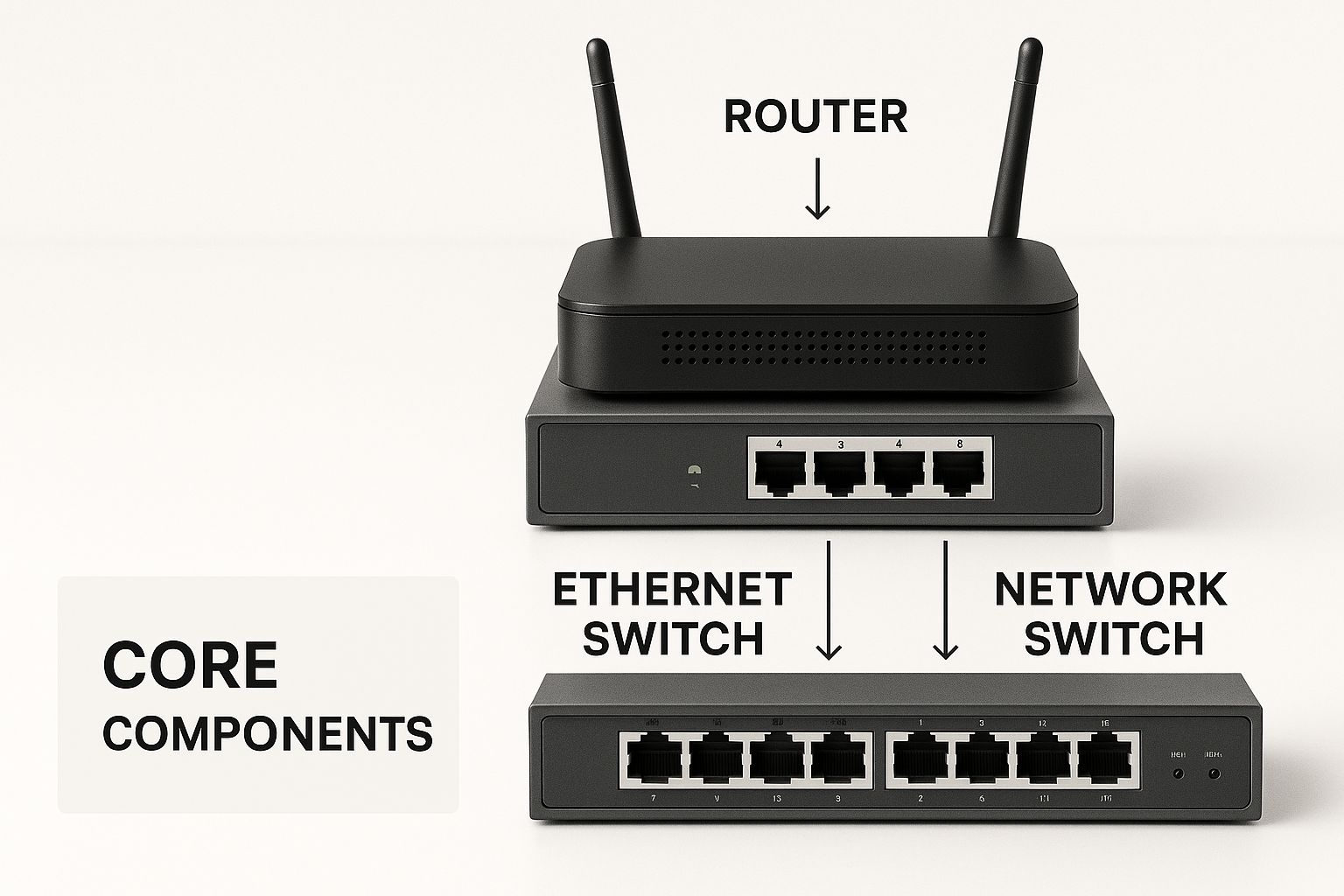
The interplay between these distinct elements is what unlocks the full capabilities of an SD-WAN architecture. Let’s delineate the specific function of each one.
The Edge Appliance (uCPE)
At each network location—be it a branch office, data center, or colocation facility—an SD-WAN Edge Appliance is deployed. Often referred to as uCPE (Universal Customer Premises Equipment), these devices can be physical hardware or virtual network functions (VNFs). They are the distributed forwarding elements of the data plane.
Their primary role is to execute policies received from the central controller.
Specifically, these appliances are responsible for:
- Establishing and maintaining secure overlay tunnels across all available transport links (MPLS, broadband, 4G/5G LTE).
- Continuously monitoring the real-time performance and health of each of those underlay connections.
- Steering application traffic across the optimal path based on predefined policies and live network conditions.
A key operational benefit is zero-touch provisioning (ZTP). An unconfigured appliance can be deployed at a remote site, and upon connection, it automatically contacts the orchestrator to download its full configuration profile, drastically reducing deployment time and operational overhead.
The Controller and Orchestrator
While the edge appliances form the distributed data plane, the SD-WAN Controller is the centralized control plane—the intelligence hub of the entire architecture. It is a software platform that provides a holistic view and programmatic control over the entire network fabric. The Orchestrator is the management plane component that provides the “single pane of glass” GUI for administrators.
This is where network policies are defined. An administrator can log in and create a business-level policy such as, “Prioritize Microsoft Teams traffic and route it over the path with jitter below 20ms.” The Orchestrator translates this intent and pushes the corresponding configuration to every edge appliance, enabling network-wide changes to be implemented in minutes. This centralized intelligence is the source of SD-WAN’s agility.
SD-WAN Gateways
Finally, SD-WAN Gateways (sometimes called cloud on-ramps) serve as high-performance, secure entry points from the SD-WAN fabric to external networks, particularly public cloud environments. They provide optimized, direct pathways to IaaS providers like AWS and Azure, as well as to SaaS applications like Salesforce or Microsoft 365.
This direct-to-cloud access is a critical feature. It eliminates the need to backhaul cloud-bound traffic to a central data center for breakout to the internet. By avoiding this inefficient traffic pattern, gateways significantly reduce latency and improve the end-user experience for cloud applications.
Gateways can also function as an interconnection point, bridging the SD-WAN fabric to legacy, non-SD-WAN sites to ensure seamless communication across a hybrid network environment. Understanding these components is a prerequisite for a comprehensive cost-benefit analysis of SD-WAN.
Core SD-WAN Architectural Components and Their Functions
This table breaks down the primary components in an SD-WAN architecture, detailing their main role and key responsibilities within the network fabric.
| Component | Primary Role | Key Functions |
|---|---|---|
| SD-WAN Edge Appliance (uCPE) | On-Site Policy Enforcement | Packet forwarding, security enforcement, link monitoring, establishing secure tunnels. |
| SD-WAN Controller/Orchestrator | Centralized Management & Intelligence | Policy creation, network monitoring, configuration distribution, zero-touch provisioning. |
| SD-WAN Gateway | Secure Cloud & Legacy Access | Optimized routing to IaaS/SaaS, bridging SD-WAN fabric to non-SD-WAN sites. |
In short, the Edge Appliance acts, the Controller thinks, and the Gateway connects. Understanding how they collaborate is key to understanding SD-WAN itself.
Key Business and Technical Benefits of Adopting SD-WAN

Having examined the “what” and “how,” let’s analyze the operational and financial impact of SD-WAN adoption. The benefits are substantial, addressing long-standing challenges in traditional networking and yielding measurable improvements in performance, cost, and agility.
By 2020, 43% of enterprises had already implemented SD-WAN in some capacity, demonstrating its strategic importance. The architecture’s core principle—centralizing the control plane in software—provides IT teams with a level of visibility and programmatic control over the WAN that was previously unattainable.
Enhanced Application Performance and User Experience
A primary technical benefit is a significant improvement in application performance. SD-WAN’s core mechanism for this is dynamic path selection. The system continuously monitors all available transport links for performance metrics such as latency, jitter, and packet loss.
This real-time telemetry enables the network to automatically steer traffic flows over the optimal path at any given moment. A latency-sensitive video conference can be dynamically moved from a degraded broadband link to a stable MPLS circuit. A large data transfer can be offloaded to a high-bandwidth connection to avoid impacting real-time applications. The result is consistent, high-quality application performance and a superior end-user experience.
Furthermore, administrators can implement highly granular Quality of Service (QoS) policies. Traffic can be prioritized based on application type, user group, or other business criteria, ensuring that critical applications like ERP or CRM systems are never starved for bandwidth.
Significant Cost Reduction and Network Agility
From a financial perspective, the potential for cost savings is a primary driver. Traditional MPLS circuits are notoriously expensive. SD-WAN enables enterprises to augment or replace these costly private lines with more economical transport options like commercial broadband and 4G/5G LTE.
By intelligently load-balancing traffic across multiple transport types, organizations can dramatically reduce their reliance on MPLS for non-critical data. This strategic use of a hybrid WAN optimizes network spend without sacrificing performance, often resulting in a significant reduction in operational expenditures (OpEx).
This architecture also introduces profound network agility. With zero-touch provisioning, deploying a new branch office is reduced from a multi-week process to a matter of hours. IT can provision new sites and manage the global network from a single orchestration platform, enabling the network to scale at the speed of business. Exploring best practices for SD-WAN is a logical next step for maximizing these benefits.
Finally, most SD-WAN solutions integrate a robust security stack, enhancing the security posture at the network edge. Common features include:
- Next-Generation Firewalls (NGFW) for stateful traffic inspection at the branch.
- Micro-segmentation to create isolated network zones and contain the lateral movement of threats.
- End-to-end encryption across all overlay tunnels, securing data-in-transit over public internet connections.
How SD-WAN Works in the Real World
Theory is one thing, but seeing how companies actually use SD-WAN to solve real-world problems is where its value truly clicks. Whether it’s making cloud apps run faster or helping a retail chain expand without the usual headaches, the technology delivers tangible results. This is where the technical definition of SD-WAN translates directly into a business advantage.
One of the most common use cases is improving performance for cloud and SaaS applications. In a traditional WAN, traffic from a branch office destined for Salesforce or Microsoft 365 is first backhauled to a central data center. This traffic path introduces significant latency, leading to poor application responsiveness and frustrated users.
SD-WAN resolves this by enabling local internet breakout. The edge appliance can identify cloud-bound application traffic and route it directly and securely to the internet over the optimal path, bypassing the corporate data center entirely. This dramatically reduces latency and delivers an immediate performance improvement for critical business applications.
Supporting Hybrid Work and Agile Retail
The shift to hybrid work models presents another ideal use case. Maintaining consistent policy and security enforcement for a distributed workforce is a significant challenge. SD-WAN extends the corporate network fabric to remote users, applying the same security posture and application prioritization policies regardless of location. This ensures all employees have secure, reliable, and performant access to corporate resources.
Enterprises with many distributed sites, such as retail and logistics, also realize significant benefits:
- Fast Site Rollouts: Provisioning a new retail store or temporary pop-up site, a process that used to take weeks, can be accomplished in hours. An SD-WAN appliance is shipped to the site, connected, and auto-provisions itself with the correct network and security policies via ZTP.
- Smarter Connectivity Costs: Instead of deploying expensive MPLS circuits at every site, retailers can utilize lower-cost broadband and 4G/LTE as primary or secondary links, drastically reducing per-site operational costs while maintaining high availability through link bonding and failover.
These real-world deployments show why the technology is critical for modern business. By enabling secure, cloud-optimized, and cost-effective networks, SD-WAN provides the agility needed to compete.
Proven Success in Healthcare and Manufacturing
The impact of SD-WAN is evident across diverse industries. With over 70% of enterprise workloads now residing outside the traditional data center, a more flexible and secure connectivity model is essential. Schneider Electric, for example, deployed SD-WAN across 25 countries, resulting in a 35% reduction in MPLS costs while simultaneously improving application performance.
Healthcare provides another compelling case study. Cleveland Clinic implemented SD-WAN across more than 140 facilities. This initiative increased system availability by 50%, a critical outcome for ensuring reliable access to telehealth platforms and electronic health records (EHR).
These examples demonstrate how a well-architected SD-WAN strategy translates directly into improved performance, reduced TCO, and greater operational agility. You can explore further industry data with these findings from MarketsandMarkets.
Where AI and Automation Fit Into Modern SD-WAN
Standard SD-WAN provides a reactive networking model, capable of responding to performance degradation as it occurs. The next evolution, however, involves integrating Artificial Intelligence (AI) and Machine Learning (ML) to create a proactive and even predictive network fabric.
This marks a fundamental shift from a reactive to a predictive operational model. The network transitions from simply reacting to a traffic jam to rerouting traffic based on a forecast that the congestion will occur.
For IT operations, this is the practical application of AIOps (AI for IT Operations) to enterprise networking. Instead of relying on static, threshold-based alerts (e.g., “alert if latency exceeds 100ms”), an AI-driven SD-WAN establishes a dynamic performance baseline. It learns the normal operational parameters for every link, application, and traffic path across the network.
This intelligent baseline is the key. The system can identify subtle deviations from normal behavior that would be imperceptible to a human operator—the early indicators of a potential brownout or link failure. This elevates network management from reactive troubleshooting to proactive remediation.
Predictive Analytics and Smarter Traffic Steering
With AI-driven analytics, traffic steering transcends simple, rules-based logic to become a sophisticated, multi-factor decision-making process. The system can analyze complex patterns across dozens of variables beyond basic latency and jitter metrics, enabling more intelligent real-time routing decisions.
The result is that every application flow is mapped to the optimal path based on its specific requirements at that moment, without requiring constant manual tuning by network engineers.
This evolution toward self-driving networks is fueling the rapid growth in the SD-WAN market, which is valued at between $3 billion and nearly $8.5 billion. The managed services sector, where AI-powered optimization is a key differentiator, is projected to become an almost $18 billion industry by 2034. This trend solidifies that the modern SD-WAN definition is one augmented by AI. To explore the data further, you can discover more insights about SD-WAN statistics at LLCBuddy.com.
Common Questions We Hear About SD-WAN
Even with a solid grasp of the architecture, several practical questions inevitably arise during the evaluation phase for an SD-WAN implementation. Here are some of the most common queries from IT professionals considering this technology.
Can We Finally Get Rid of MPLS?
This is often the first question asked. The answer is: it depends on your specific business requirements and risk tolerance.
For many organizations, the optimal strategy is not a full rip-and-replace but a hybrid WAN approach. They retain MPLS circuits for applications with stringent SLAs that demand deterministic performance, such as real-time voice or critical transactional data. They then offload all other traffic—general internet, SaaS applications—onto lower-cost broadband and LTE links.
Conversely, some enterprises, particularly those without extreme uptime requirements, can decommission MPLS entirely. A solution that bonds multiple commodity internet links can provide sufficient performance and high availability through redundancy, but at a fraction of the cost.
How Does Security Work with SD-WAN?
This is a critical consideration. If SD-WAN enables local internet breakout from the branch, how is security maintained without backhauling traffic to a centralized firewall? Modern SD-WAN architectures address this by integrating security functions directly into the edge appliance.
This distributed security model, often termed SASE (Secure Access Service Edge) when cloud-delivered, typically includes:
- A Next-Generation Firewall (NGFW) for stateful inspection and threat prevention at the branch.
- Secure Web Gateways (SWG) for URL filtering, malware protection, and policy enforcement.
- Micro-segmentation, which logically isolates network segments to prevent the lateral movement of threats in the event of a breach.
By distributing the security stack to the edge, SD-WAN not only simplifies the network topology but also strengthens the overall security posture. It moves from a perimeter-based model with a single chokepoint to a distributed, zero-trust framework where each site is a secure enforcement point.
How Do I Choose the Right SD-WAN Vendor?
With a crowded marketplace, vendor selection requires careful due diligence. It’s crucial to look beyond marketing claims and evaluate solutions based on specific technical and business requirements.
Key evaluation criteria should include the platform’s integration capabilities with your IaaS environments like AWS, Azure, or GCP. Scrutinize the depth and efficacy of their security features—are they native functions or bolted-on third-party services? Also, consider the management model. Do you have the in-house expertise for a DIY approach, or is a co-managed or fully managed service a better fit for your operational model?
A vendor optimized for a large-scale retail deployment may not be the ideal choice for a healthcare organization with strict HIPAA compliance mandates. The right solution is one that aligns directly with your technical requirements, security posture, and operational reality.
At Mushroom Networks Inc., we specialize in advanced SD-WAN solutions that leverage broadband bonding technology to deliver exceptional link reliability and aggregated speed. Our appliances feature integrated firewalls and granular QoS capabilities to ensure your network is fully optimized for your specific business applications.
See how our multi-WAN technology can build a resilient, high-performance network for you at Mushroom Networks.