Edge AI is changing where organizations process data. Instead of sending every camera stream, sensor reading, or machine event to a distant cloud, more of the work can happen close to the equipment that generates it. That reduces delay, keeps operations moving when the WAN is unstable, and limits how much raw data has to leave the site.
GigaIO’s official partnership announcement highlights the next challenge: local computing power alone is not enough. Edge systems still need reliable paths to other edge locations, central facilities, data centers, and cloud services. That is the problem Mushroom Networks and GigaIO are working together to solve.
From Data Center AI to the Operational Edge
AI infrastructure is becoming more distributed. Large training jobs may remain in a data center, but inference and real-time decision-making increasingly belong closer to factories, vehicles, emergency sites, farms, mines, and energy facilities. In these environments, sending every input to the cloud can add too much delay or consume more bandwidth than the available connection can support.
GigaIO's edge systems bring substantial computing resources to those locations. Its portable Gryf platform packages compute, GPU, storage, and networking into a field-ready system, while Manticore provides a larger near-edge platform for sites that need to process data from many cameras, sensors, or instruments. The goal is not to replace the cloud. It is to place the right processing at the right point in the system.
That architecture has clear advantages:
- Lower latency: Time-sensitive inference can happen close to the machine, camera, or operator.
- Operational continuity: Local processing can continue during an upstream outage or congestion event.
- Better bandwidth use: The edge can send results, alerts, and selected data instead of every raw stream.
- More control: Sensitive operational data can remain onsite unless policy requires it to move.
The Network Becomes Part of the AI System
Moving compute closer to the workload does not remove the network requirement. It changes it. Edge systems still need to receive model updates, synchronize selected datasets, report health and performance, support remote administration, and send important results to people or systems elsewhere.
The difficult locations are often the ones with the least predictable connectivity. A facility may have fiber plus private 5G. A mobile command site may depend on several cellular carriers and satellite. A temporary industrial site may have only wireless links, each with different capacity, latency, coverage, and failure patterns.
A single connection can become a bottleneck even when the edge computer has more than enough processing power. Basic failover helps after a link fails, but it does not use the combined capacity that is already available, and a failover event can interrupt active sessions. For real-time video, telemetry, and remote control, that interruption can matter.
What the Mushroom Networks and GigaIO Partnership Combines
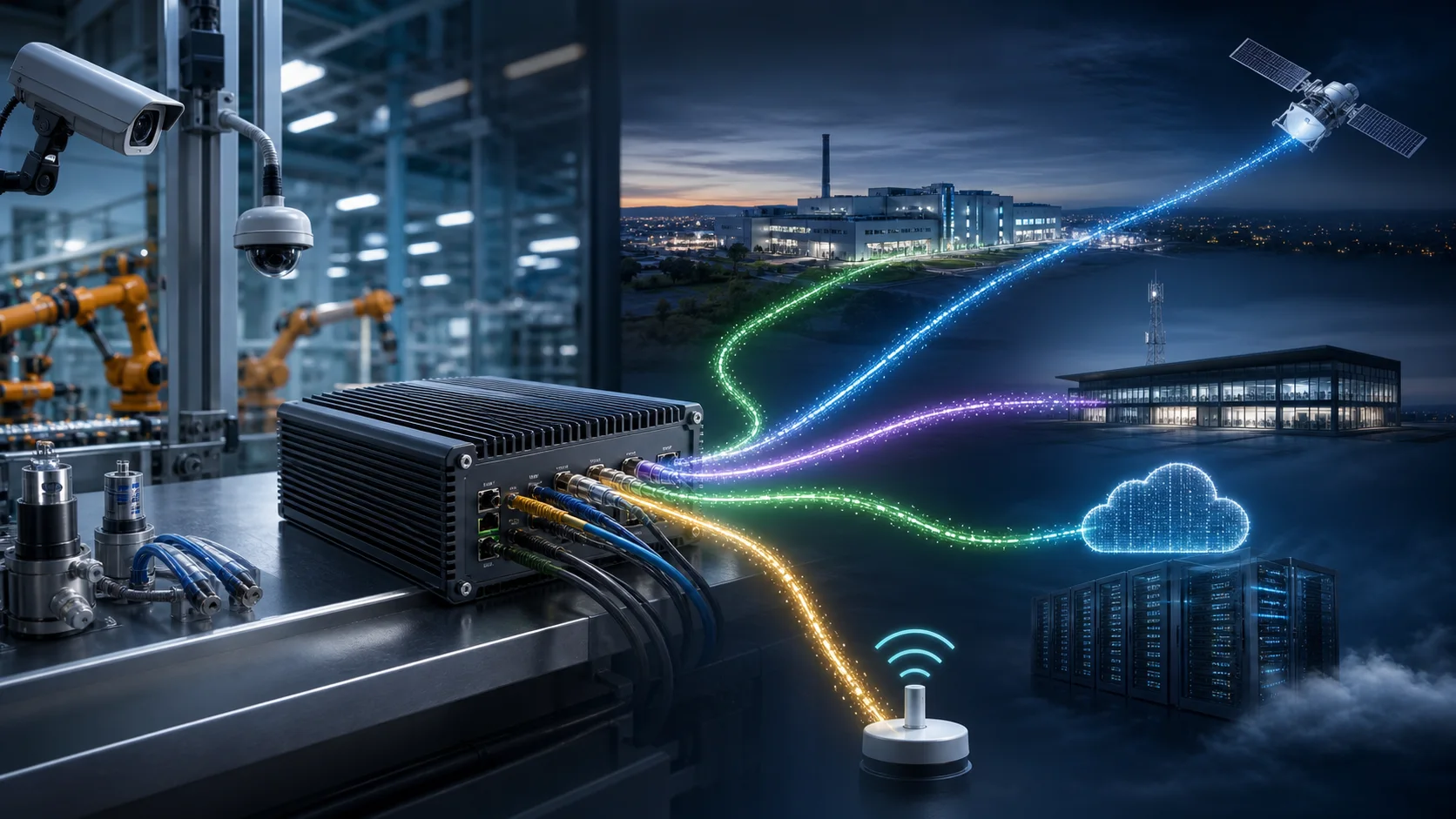
The partnership pairs GigaIO's edge computing platforms with Mushroom Networks' broadband bonding technology. Multiple wired and wireless connections can operate as one resilient path between far-edge systems and near-edge or central infrastructure.
Depending on the site, that mix can include Wi-Fi, cellular, private 5G, fiber, and satellite. Mushroom Networks software continuously measures those links and can distribute traffic according to their real-time condition. If one path degrades or disappears, traffic can continue across the remaining links.
This is the same practical foundation behind our Broadband Bonding Service, cellular bonding, and SD-WAN solutions: use link diversity to improve bandwidth, reliability, and application performance instead of forcing an important workload to depend on one circuit.
A Practical Edge AI Data Flow
A well-designed edge AI system does not simply move all data in one direction. It separates local, upstream, and control traffic according to what each workload needs.
- Capture data locally. Cameras, industrial sensors, vehicles, or scientific instruments send data to the edge system.
- Process urgent workloads onsite. The local GPU runs inference, detects events, or produces an immediate control response without waiting for a cloud round trip.
- Move selected information upstream. Alerts, summaries, chosen video clips, and records needed for analysis travel to a near-edge facility, data center, or cloud service.
- Bring updates back to the edge. New models, configuration changes, and operating policies flow from central systems to remote sites.
- Maintain remote visibility. Operations teams monitor the health of both the compute platform and its connectivity.
Each flow has a different tolerance for delay, loss, and interruption. Bonding makes it possible to use the available paths as a coordinated resource, while traffic policies keep a large background transfer from competing unfairly with a live control or video session.
Why Bonding Matters Beyond Simple Failover
Edge AI connectivity is not only about surviving a complete outage. Wireless quality can change gradually, congestion can appear without warning, and uplink capacity may be much lower than download capacity. A resilient design should respond before a connection becomes unusable.
With intelligent bonding, the system can combine bandwidth when an application can benefit from it, steer traffic away from an impaired path, and preserve sessions while link conditions change. The result is a more stable transport layer for applications that were designed around a dependable network but must operate in the real world.
For organizations connecting several sites or clouds, this approach can also work with private overlay tunnels. Our guide to connecting hybrid AI infrastructure across cloud, data center, and edge explains how Virtual Leased Line tunnels can extend Layer 2 connectivity across bonded internet paths when that network model is appropriate.
Where This Architecture Fits
The combination is useful wherever high-value data is generated outside a conventional data center and reliable fixed connectivity cannot be assumed.
Manufacturing and Industrial Operations
Local inference can inspect products, identify equipment problems, or coordinate robotics. Bonded connectivity then carries alerts, production summaries, and selected video to plant or enterprise systems. This is especially valuable across large engineering and construction environments where network conditions differ from one work area to another.
Emergency and Field Operations
Portable compute can analyze live video and sensor inputs at an incident site. Diverse cellular, Wi-Fi, and satellite paths help an emergency response team maintain communication even as coverage and congestion change.
Defense and Remote Infrastructure
Remote sites may need local autonomy while still exchanging selected intelligence with command systems. Link diversity provides an important layer of resilience for government and defense networks, as well as agriculture, mining, and energy operations located far from traditional infrastructure.
Questions to Answer Before Deployment
The best edge architecture starts with the workload, not the hardware list. Before deployment, teams should document:
- Which decisions must remain local, and which data must leave the site?
- What are the latency, throughput, and availability requirements for each traffic flow?
- Which independent carriers and access technologies are actually available at the location?
- How should critical, interactive, and background traffic be prioritized?
- What happens when bandwidth falls below normal levels rather than failing completely?
- How will the team test link loss, congestion, recovery, and remote management before production use?
These answers determine the right mix of local compute, WAN links, bonding policies, security controls, and observability. They also prevent overbuilding one part of the system while leaving another as a hidden single point of failure.
A Complete Edge Platform Needs Compute and Connectivity
Edge computing reduces the amount of data that must cross the WAN, but it does not make connectivity optional. Useful edge AI still depends on dependable movement of models, results, selected data, and operational traffic. GigaIO supplies the processing close to the workload; Mushroom Networks supplies a resilient way to connect that processing to the rest of the organization.
If you are planning an edge AI deployment, contact Mushroom Networks to discuss the available links, application requirements, and failure conditions at your sites. A short network design review can reveal whether bonding, traffic steering, and private tunnels should be part of the architecture from the start.